
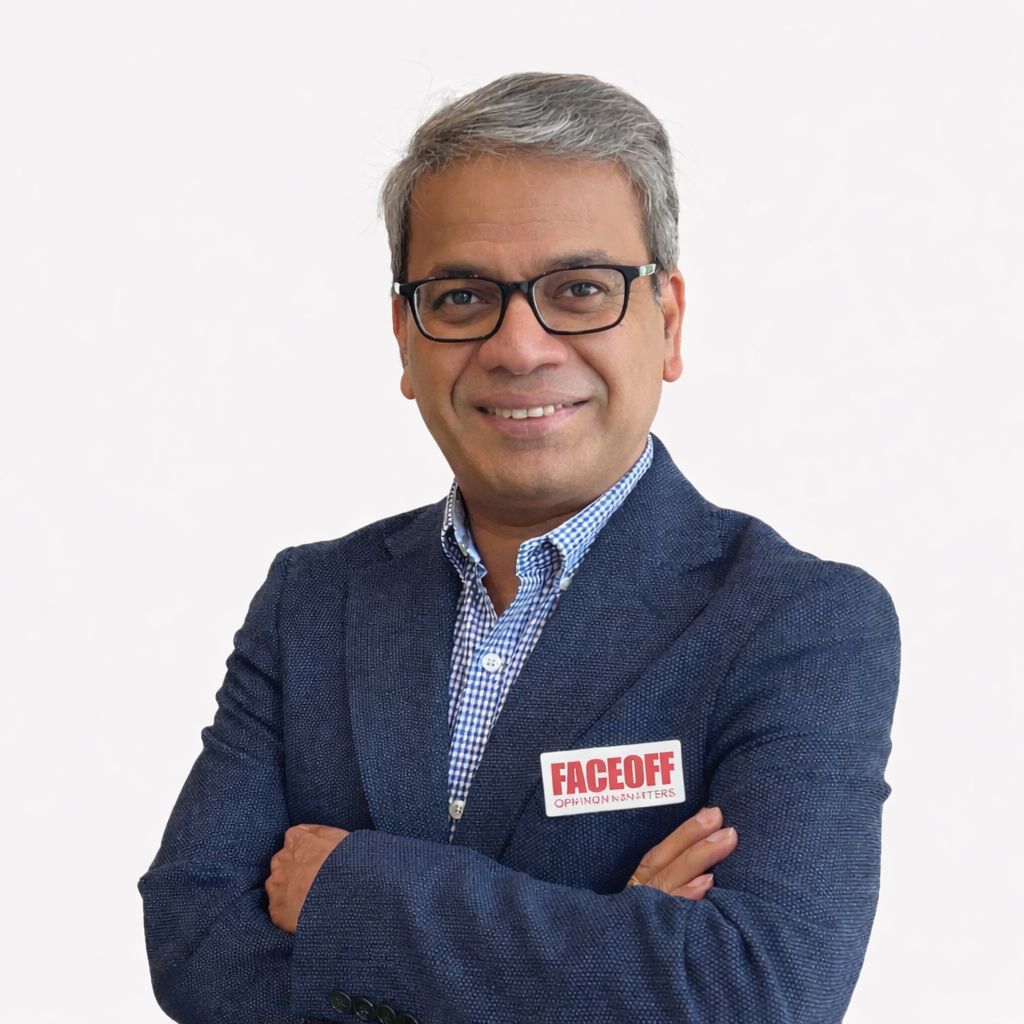

A Thought Leadership POV by Dr. Damodar Sahu
Founding Partner & Chief Growth Officer, Faceoff Technologies Inc. | Founder, MuliaSmarak & DaMo Speaks | Global Growth & Partnerships Leader | Speaker, Mentor & Thought Leader
The world is entering one of the most transformative periods in human history.
Artificial Intelligence is reshaping industries, redefining careers, accelerating innovation, and altering the way societies function. We are witnessing a future where machines can create content, predict behavior, automate decisions, and influence human interactions at an unprecedented scale.
Yet amid all this technological acceleration, one fundamental question remains:
Will humanity evolve as fast as technology?
I believe the defining leadership challenge of the coming decade will not merely be innovation. It will be responsibility.
The future will belong to leaders who can combine intelligence with empathy, growth with ethics, and ambition with contribution.
As someone who has spent nearly three decades across technology ecosystems, global partnerships, digital transformation, startups, mentorship, education, and social impact initiatives, I have increasingly realized that the most powerful technologies in the world still depend on deeply human values: trust, purpose, collaboration, and compassion.
And perhaps that realization began much earlier than my corporate journey.
From Bellaguntha to Global Ecosystems
I come from Bellaguntha, a small town in Odisha, India.
Growing up in a modest environment teaches you something that elite institutions often cannot. You learn the value of resilience, relationships, gratitude, and community.
In small towns, people may not possess great wealth, but they understand interdependence. Progress is rarely individual; it is collective.
Those early experiences shaped my worldview long before I entered boardrooms, technology conferences, or global business ecosystems.
When I later joined Wipro and spent over a decade working across digital transformation, manufacturing innovation, Industry 4.0 initiatives, strategic partnerships, customer engagement, and global ecosystem-led growth, I saw another side of the world: scale.
I witnessed how technology could transform industries, improve operational efficiency, accelerate decision-making, and unlock new business models.
But I also observed something equally important.
Organizations that succeeded sustainably were not always the ones with the most advanced technology.
They were the ones that built trust.
Trust between leaders and teams.
Trust between companies and customers.
Trust between innovation and ethics.
Today, as AI rapidly evolves, this lesson has become more important than ever.
AI Is Advancing Fast. Human Responsibility Must Advance Faster.
The global conversation around AI often focuses on capability.
Can machines become more intelligent?
Can systems become more autonomous?
Can businesses scale faster using AI?
But I believe we are asking an incomplete question.
The more important question is this:
Can humanity become more responsible while building these systems?
We are entering an era where synthetic identities, deepfakes, algorithmic manipulation, misinformation, privacy breaches, and digital trust challenges are becoming realities.
Technology no longer simply supports society.
It shapes perception, influences behavior, and impacts democracy, education, business, and human relationships.
This is precisely why conversations around ethics and digital trust cannot remain secondary discussions.
At Faceoff Technologies Inc., where we focus on AI-powered trust verification, synthetic identity detection, and digital truth infrastructure, I see firsthand how critical digital trust infrastructure will become in the future.
In the coming decade, trust may become the most valuable currency in the digital economy.
People will not only ask whether systems are intelligent.
They will ask whether systems are trustworthy.
And that changes the responsibility of leadership.
Future leaders must move beyond building scalable systems.
They must build responsible ecosystems.
The Shift From Competitive Leadership to Collaborative Leadership
For decades, leadership models were heavily centered around competition.
Who grows faster?
Who scales bigger?
Who dominates markets?
But the future will increasingly reward collaboration.
The world’s biggest challenges – AI ethics, climate resilience, cybersecurity, workforce transformation, education inequality, and digital trust cannot be solved in silos.
This is why ecosystem-led leadership has become essential.
Throughout my professional journey, one principle repeatedly proved true: long-term growth is rarely achieved alone.
Partnerships create scale.
Communities create resilience.
Mentorship creates continuity.
The strongest leaders are not those who try to become the center of every conversation.
They are the ones who create platforms where others can grow.
This philosophy eventually evolved into a deeply personal belief for me:
“Rise by Lifting Others.”
What began as a simple thought gradually became a way of looking at leadership, relationships, business, and social responsibility.
Because true success becomes meaningful only when it creates opportunities for others.
Personal Social Responsibility: A Leadership Model for the Future
Corporate Social Responsibility transformed how organizations think about societal contribution.
But I believe the future also requires something more personal.
That is where the idea of Personal Social Responsibility (PSR) emerged for me.
PSR is the belief that every individual not just institutions has a responsibility to contribute positively to society using their time, knowledge, influence, or resources.
This belief became one of the inspirations behind MuliaSmarak, a social initiative created to support the education of underprivileged students from my hometown region in Odisha.
MuliaSmarak is deeply personal to me because it represents more than educational support; it represents gratitude, remembrance, and responsibility. Inspired by the values of my late father, the initiative reflects a belief that true progress must include those who may not have equal access to opportunities.
Through MuliaSmarak, we have tried to create not only financial assistance for students, but also encouragement, mentorship, and hope. Over time, I realized that sometimes the most meaningful leadership happens quietly through enabling someone else’s future.
Education changes trajectories.
A scholarship may support one student, but the ripple effect can influence entire families and future generations.
In many ways, education is one of the most scalable forms of social transformation.
As professionals become more successful globally, I believe there is a growing need to reconnect achievement with responsibility.
Leadership should not end at career success.
Leadership should extend into community impact.
The future needs leaders who measure success not only through valuation, titles, or visibility, but also through contribution.
Why Mentorship Matters More Than Ever
One of the greatest gifts in my journey has been the opportunity to mentor startups, students, founders, and professionals.
Mentorship is often underestimated because its outcomes are not always immediately visible.
But mentorship creates compounding impact.
A single conversation can restore confidence.
A shared insight can prevent years of struggle.
An encouraging word can reignite someone’s ambition.
In a rapidly changing world, mentorship has become even more critical because knowledge alone is no longer enough.
People are seeking clarity.
They are seeking direction.
They are seeking meaning.
The future workforce will not simply require technical skills.
It will require emotional resilience, ethical thinking, adaptability, and collaborative intelligence.
This is why leaders must become teachers.
Not necessarily in classrooms, but through conversations, guidance, and example.
I strongly believe one of the most important responsibilities of experienced professionals is to create pathways for others.
Not gatekeeping.
Not hierarchy.
But enablement.
Because societies progress faster when knowledge is shared generously.
Human-Centered Leadership in the AI Era
Technology will continue evolving.
AI systems will become more advanced.
Automation will increase.
Digital ecosystems will expand.
But human-centered leadership will become even more valuable—not less.
Why?
Because the more automated the world becomes, the more people will seek authenticity.
Employees will seek leaders who genuinely care.
Customers will trust organizations that operate transparently.
Communities will support institutions that act responsibly.
The future belongs to leaders who can combine:
Innovation with integrity
Intelligence with empathy
Strategy with humanity
Scale with trust
Success with service
Human-centered leadership is not about being soft.
It is about being conscious.
It is about understanding that sustainable growth must include human dignity, ethical responsibility, and social impact.
The most respected leaders of the future may not necessarily be those with the loudest voices.
They will be those who build trust consistently.
The Role of Public Voices in a Distracted World
We are living in an era of constant noise.
Social media rewards speed over depth.
Visibility often gets confused with credibility.
And influence is increasingly measured through algorithms rather than substance.
This creates a new responsibility for public speakers, educators, leaders, and thought influencers.
Our role is no longer simply to motivate.
Our role is to create meaningful reflection.
Through DaMo Speaks and various speaking engagements across technology, leadership, education, startups, partnerships, and social impact forums, I have learned that audiences today are not looking only for information.
DaMo Speaks began as a simple effort to create authentic conversations around life, leadership, resilience, innovation, purpose, and human potential. Over time, it evolved into a platform where professional experiences, personal reflections, social observations, and future-facing ideas could come together meaningfully.
Whether discussing AI ethics, startup journeys, career transformation, emotional resilience, or the philosophy of “Rise by Lifting Others,” the intention behind DaMo Speaks has always remained the same; to inspire people to think deeply, act responsibly, and grow meaningfully.
They are looking for authenticity.
People connect with real experiences.
They connect with vulnerability.
They connect with purpose.
In a world flooded with content, thoughtful communication becomes leadership.
And thoughtful leadership requires listening as much as speaking.
The Future Will Belong to Builders of Trust
As I reflect on my journey – from Bellaguntha to global technology ecosystems, from corporate boardrooms to social initiatives, from startup mentoring to public speaking; one realization stands above everything else.
The future will not simply be built by the smartest people.
It will be built by the most trustworthy people.
Because technology alone cannot sustain civilizations.
Human values do.
The leaders who will matter most in the coming decade are those who:
Create opportunities for others
Build ethical systems
Lead with empathy
Invest in education
Mentor future generations
Use influence responsibly
Build partnerships instead of silos
Combine innovation with integrity
The world does not merely need more successful individuals.
It needs more responsible leaders.
And perhaps that is the real evolution humanity now requires.
Not just Artificial Intelligence.
But Elevated Humanity.
Closing Reflection
When future generations look back at this era, they may not remember every technology we created.
But they will remember the values with which we used them.
They will remember whether leadership became more compassionate.
Whether innovation became more responsible.
Whether success became more inclusive.
And whether those who had the ability to rise also chose to lift others.
Because ultimately, the greatest legacy any leader can leave behind is not influence.
It is impact.
And impact begins when humanity remains at the center of progress.
About the Author
Dr. Damodar Sahu is a global growth leader, speaker, startup mentor, and advocate of Personal Social Responsibility (PSR). With nearly three decades of experience across digital transformation, AI-driven innovation, partnerships, ecosystem-led growth, and leadership engagement, he has worked across global technology ecosystems and spoken at industry, education, and social impact platforms.
He is the Founding Partner & Chief Growth Officer of Faceoff Technologies Inc., an AI-powered trust verification and digital truth infrastructure company, and the founder of MuliaSmarak and DaMo Speaks.
MuliaSmarak is a social initiative supporting education for underprivileged students in Odisha, India, while DaMo Speaks is a growing platform focused on purposeful conversations around leadership, technology, humanity, resilience, and social impact.
His philosophy is rooted in one belief:
“Success becomes meaningful when it creates value for others.”
