Dikhyaa Mohanty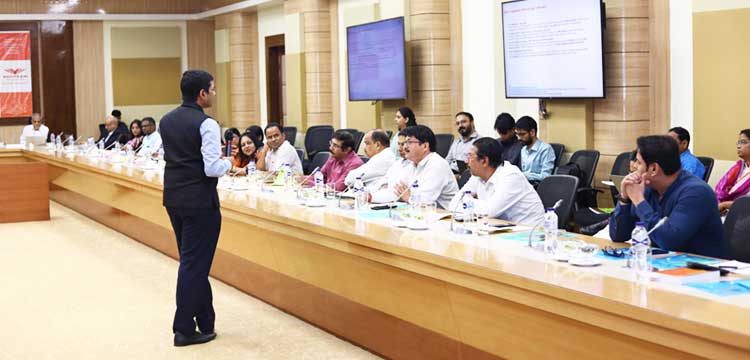
At the State Convention Centre, Lok Seva Bhavan, on Wednesday, the Electronics and Information Technology (E&IT) Department of the Odisha government, in partnership with the Wadhwani Foundation, hosted a groundbreaking one-day workshop entitled “AI and Emerging Technologies for Government Digital Transformation.” principal Secretary Manoj Ahuja was the principal guest at the event, which was the first of several training sessions designed to give government personnel artificial intelligence (AI) capabilities to improve governance and public service delivery.
Principal Secretary of the E&IT Department Vishal Dev, Special Secretary Manas Panda, CEO of the Wadhwani Centre for Government Digital Transformation Prakash Kumar, senior officials from other departments, representatives from the Wadhwani Foundation, and participants from Odisha’s digital governance ecosystem were among the important stakeholders who attended the workshop. The program is in line with Odisha’s plan to increase institutional preparedness for using AI and data-driven methods in all areas of government.
In his address, Chief Secretary Manoj Ahuja emphasized AI’s transformative potential, stating, “AI can radically simplify how citizens interact with the state, turning complex processes into seamless ones. Our officers must embrace emerging technologies to build responsible, AI-driven systems that deliver faster, transparent, and efficient services. This is Odisha’s opportunity to lead nationally.”
Principal Secretary Vishal Dev outlined Odisha’s ambitious roadmap for AI adoption, saying, “We are positioning Odisha as a national leader in AI through the upcoming Odisha AI Policy and the launch of the Odisha AI Mission. Our partnerships with NASSCOM, the Wadhwani Foundation, and the establishment of an AI Centre of Excellence in Bhubaneswar reflect our commitment to a robust AI ecosystem. We are also collaborating with the India AI Mission to pilot AI solutions across departments, fostering innovation and inclusive governance.”
With sessions examining generative AI tools, their function in complicated analysis and content creation, and implementation models that prioritize privacy, security, data ethics, and bias reduction, the event gave participants practical experience with AI applications in governance. Participants worked on real-world AI projects, such as an AI tool for pregnant women’s at-home screening, a generative AI assistant for instructors, and a platform for citizen involvement.
Predictive analytics for real-time monitoring, data-driven decision-making, and structured frameworks for transforming concepts into scalable AI initiatives were the topics of further conversations. In order to evaluate technical viability and get expert input, participants were required to identify governance concerns, which they would then study in collaboration with the Wadhwani Foundation.