

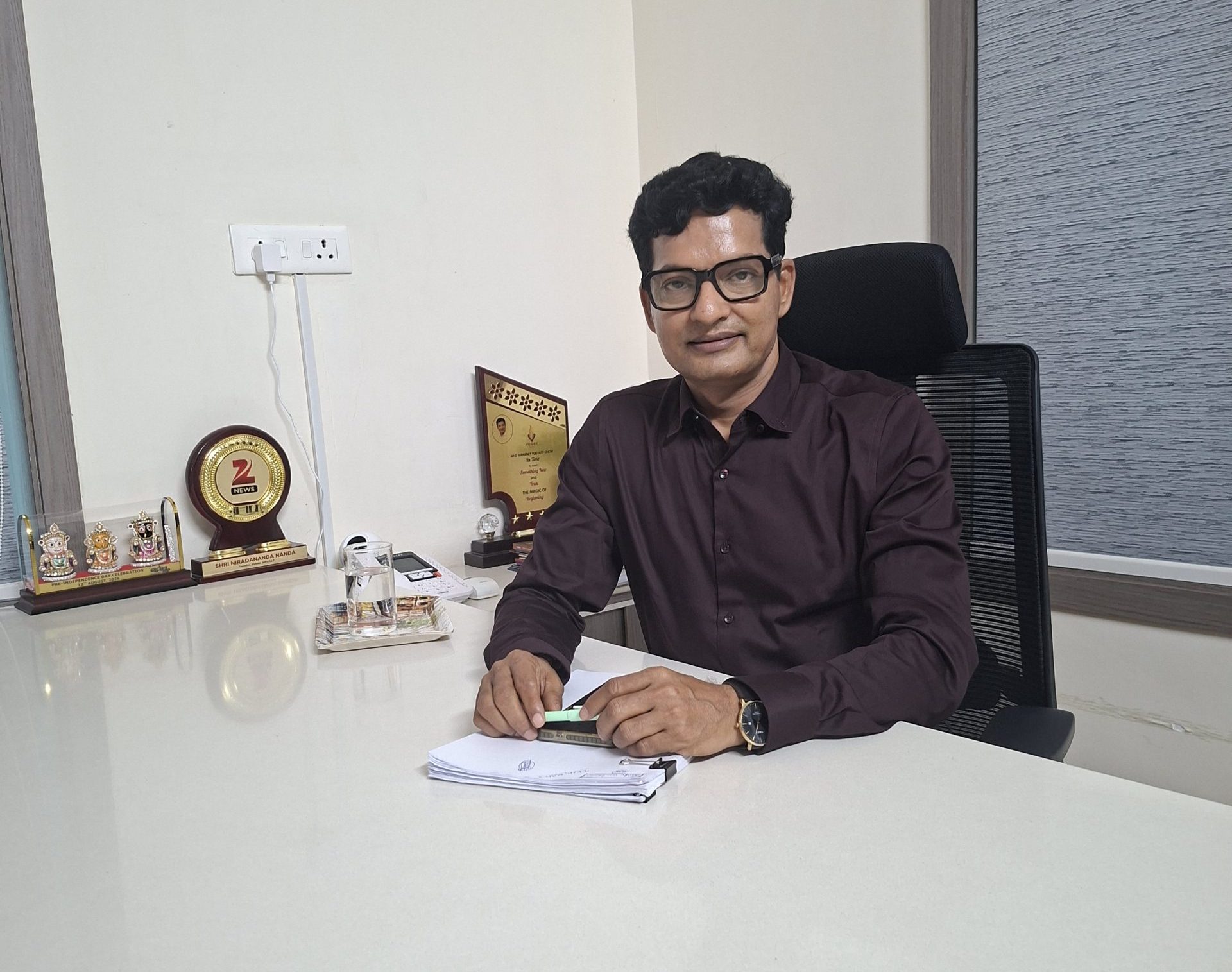
From his early exposure to the social sector and urban communities to the establishment of Vumee Infra and the vision behind Vumee Amrapalli, Niradananda Nanda’s journey reflects an evolving understanding of development, one where buildings, businesses and cities ultimately derive their meaning from the people they serve.
There are entrepreneurs whose stories begin with a business plan, an investment opportunity or an ambition to enter a particular industry. Then there are those whose entrepreneurial identities take shape gradually, influenced by years of working with people, observing communities, understanding cities and experiencing different professional environments. Niradananda Nanda belongs to the latter category. Today, his name is increasingly associated with Vumee Infra and its ambitious residential development, Vumee Amrapalli, but the story behind that identity stretches much further back. His journey has moved through social engagement, urban development, business, infrastructure and real estate, with each phase contributing to the way he appears to understand development today.
Looking at Nanda’s journey only through Vumee Infra would therefore tell only part of the story. His professional trajectory suggests something broader: an evolution from understanding people and communities to understanding cities and structures, and eventually to creating spaces intended for people to inhabit. It is this connection between people, places, trust and development that provides the strongest thread running through his story.
A Journey That Began Long Before Vumee
Nanda’s professional and entrepreneurial journey predates the formation of Vumee Infra by many years. Public corporate records trace his business involvement back to 2008, when he became associated with Nami Enterprisers Private Limited as a director. His later corporate journey included an association with Baikuntha Balia Consultancy & Developer Private Limited in 2018, the incorporation of Vumee Infra LLP in 2023, and an association with NBB Infratech LLP in 2024. This timeline is significant because it changes the way his present identity should be understood. Vumee was not the sudden beginning of his professional career; rather, it emerged after years of experience across different environments.
What makes that journey more interesting is that it was not restricted to conventional real estate. His broader professional narrative includes exposure to the social sector, community-oriented work, urban structures and urban development. These experiences placed him in environments where development could be understood from perspectives very different from those of a property developer. Before thinking about premium residences, amenities or high-rise towers, there was an opportunity to observe communities, social realities and the ways people interact with the spaces around them. Those experiences provide an important foundation for understanding the philosophy that later emerged around his real-estate work.
The Social Sector: Understanding Development Through People
The social-sector chapter of Nanda’s journey is particularly important because it introduces the human dimension that appears repeatedly in his later professional philosophy. Working around communities can reveal realities that are sometimes invisible from corporate offices: differences in access, infrastructure, housing, opportunities and everyday living conditions. Development, viewed from this perspective, is no longer an abstract idea measured only through investment or construction. It becomes something that directly affects how people live, move, work and experience their surroundings.
This experience also provides context to Nanda’s publicly expressed belief that real estate is not simply about properties, but about people. The statement becomes more meaningful when viewed alongside a career that encounters social realities before moving deeper into property development. It suggests that the value of a building cannot be understood only through concrete, square footage or commercial returns. Ultimately, someone has to inhabit that space, build a family there, interact with neighbours and make the property part of everyday life. In that sense, understanding people becomes just as important as understanding property.
From Social Work to Understanding Urban Structures
As Nanda’s professional journey moved toward urban structures and urban development, another dimension was added to his understanding of development. If social-sector exposure offered insights into how people live, urban-development work offered an opportunity to understand the systems and physical structures that shape those lives. Housing, roads, infrastructure, accessibility, planning and neighbourhood development may appear to be separate subjects, but together they determine how successfully a city functions and how comfortably its residents experience it.
This intersection between people and physical environments is especially relevant to real estate. A residential project cannot truly exist independently of the city around it. Its value is influenced by roads, workplaces, educational institutions, healthcare facilities, public infrastructure, transportation and the character of the surrounding neighbourhood. A building may technically end at its boundary wall, but the experience of living there extends much further. Nanda’s progression from community-oriented environments toward urban development therefore provides a logical bridge to his eventual work in real estate.
Exposure to Different Urban Realities
Another important part of Nanda’s journey was his exposure to different forms of urban communities, including challenging settlement and slum structures. This creates an interesting contrast with the kind of residential environment he is involved in creating today. At one end of the urban housing spectrum are communities where residents may struggle with infrastructure, space, sanitation, accessibility and basic living conditions. At the other are premium residential developments designed around privacy, comfort, recreation, greenery, technology and convenience.
Encountering different ends of this spectrum can significantly broaden the meaning of the word “home.” A home is not simply four walls or a financial asset. Its quality is influenced by safety, ventilation, accessibility, dignity, privacy, community, connectivity and the everyday experience of the people living there. This creates one of the strongest questions surrounding Nanda’s professional journey: what does seeing different forms of urban housing teach a person about what people genuinely need from the spaces they call home? That question connects his earlier experiences directly with his present work.
Entering the World of Real Estate
By the time Nanda’s career moved deeper into real estate, he had already encountered several dimensions of development. He had seen communities from a social perspective and cities from an urban-development perspective. Real estate brought those worlds together because it sits at the intersection of land, architecture, infrastructure, finance, construction and human aspiration. A residential project begins as a commercial and technical exercise, but once completed, it becomes part of the daily lives of hundreds of people.
This is why Nanda’s transition into real estate can be viewed as more than simply a change of industry. It created an opportunity to translate observations about people and urban environments into physical spaces. A building is a structure, but a residential development eventually becomes a neighbourhood within a neighbourhood. Children grow up there, families interact, communities develop and everyday routines take shape around the environment that has been created. The developer therefore influences much more than the appearance of the building.
2023: The Beginning of Vumee Infra
A major turning point arrived in 2023 with the incorporation of Vumee Infra LLP. For Nanda, this represented a new phase in which years of professional experience could begin taking shape under an independent identity. Starting or leading a company creates a very different relationship with the work. The reputation of the organisation becomes connected with the reputation of the people behind it, while every customer experience contributes to how that identity develops in the market.
For a young real-estate brand, this responsibility becomes particularly significant. Established companies can rely on decades of completed projects and accumulated market recognition, whereas a newer developer has to establish credibility project by project and customer by customer. Quality, communication, transparency, delivery and after-sales relationships therefore become part of something larger than a single transaction. They gradually create the reputation of the company itself. For Nanda, Vumee represents not merely another professional association but an opportunity to build an identity connected directly with his own approach to development.
Success Defined Through Trust and Satisfaction
One of the most compelling aspects of Nanda’s personal philosophy is the importance he appears to place on trust. In real estate, trust is particularly important because purchasing a home is among the largest financial commitments many people make. Buyers are not simply paying for an apartment; they are placing confidence in a developer’s promises regarding construction quality, documentation, timelines, pricing, maintenance, amenities and the eventual experience of living in the project.
This gives success a meaning beyond financial returns or the number of buildings completed. It can also be measured through customer satisfaction, professional credibility and the confidence that people place in an organisation over time. The questions become more personal: Did people trust the work? Were customers satisfied? Can the developer stand confidently behind what was created? Has the work built an identity that people recognise? In this interpretation, trust becomes both a measure of success and an asset that takes years to develop.
Building an Identity in Society
Professional identity is rarely created by a title alone. It is built gradually through work, relationships, credibility, trust and recognition. Nanda’s career offers an example of this process because his present identity is the outcome of a much longer professional evolution. Different industries and experiences came before Vumee, and each contributed another layer to his understanding of business and development.
Vumee Infra can therefore be viewed as part of a larger effort to create an independent professional identity. When entrepreneurs build organisations of their own, the distinction between personal reputation and corporate reputation often becomes increasingly narrow. The quality of a project reflects on the company, while the company’s behaviour reflects on the individual leading it. Over time, this relationship can determine whether a business is simply known for what it sells or respected for what its name represents.
Simple Living and a Larger Vision
An interesting dimension of Nanda’s personality is the contrast between personal simplicity and professional ambition. Ambition does not necessarily have to express itself through extravagance. A person can remain grounded in everyday life while imagining projects of considerable scale. Similarly, remaining connected with ordinary people does not prevent an entrepreneur from pursuing a premium residential vision.
This contrast becomes particularly relevant when considered alongside Nanda’s earlier exposure to communities and different urban realities. Staying grounded can provide an important reminder that development ultimately has to serve the people who use it. Regardless of how impressive a project appears architecturally, its real test comes through everyday experience: whether residents feel comfortable, whether spaces function effectively, whether communities can develop naturally and whether the promises made during the sale are reflected in the completed environment.
Vumee Amrapalli: Giving Physical Form to a Vision
The most visible expression of Vumee Infra’s current residential vision is Vumee Amrapalli, located in Kalarahanga near Patia Station Square, Bhubaneswar. Positioned as a premium lifestyle residential project, Amrapalli is planned as a 26-storey twin-tower development, offering residential configurations ranging from 2 BHK to 3.5 BHK homes. Yet focusing only on the scale of the towers or the apartment configurations would overlook the more interesting idea behind the project.
The name Amrapalli itself carries a conceptual identity. Official project material associates it with the serenity and abundance of a mango grove, connecting the project with ideas of greenery, openness, natural light, fresh air, calm and reconnection. This creates an intriguing contrast: Amrapalli is fundamentally a vertical urban structure, yet its conceptual inspiration comes from nature. The development therefore attempts to combine the efficiency and scale of contemporary high-rise living with an environment intended to provide openness and breathing space.
Rethinking the Meaning of Premium Living
The idea behind Amrapalli also opens a broader conversation about what “premium” actually means in today’s housing market. Traditionally, premium or luxury residences were often identified by larger apartment sizes, expensive finishes, imposing entrances or high prices. Today’s homebuyers, however, increasingly consider a much wider range of factors before deciding what constitutes a premium living experience.
Location, accessibility, architecture, construction quality, privacy, ventilation, natural light, security, technology, amenities, maintenance and community spaces can all contribute to the quality of everyday life. Premium living can therefore be understood less as visible excess and more as the reduction of everyday inconvenience. A thoughtfully designed residence that saves time, provides privacy, encourages healthier living and creates comfortable common spaces may offer a form of luxury that cannot be measured purely through square footage. In this sense, premium living becomes an experience rather than simply a price category.
Creating a ‘Space to Breathe’
One of the recurring ideas associated with Amrapalli is the concept of creating “space to breathe.” The phrase carries particular relevance in rapidly developing urban environments where increasing population density and vertical construction can reduce people’s sense of openness. Contemporary residential design therefore faces the challenge of accommodating more people without making everyday life feel unnecessarily compressed.
Amrapalli’s stated design proposition includes generous residential floor heights, large-format windows, elevated corridors, hotel-inspired floor lobbies, multiple podium levels and spaces intended for recreation and community interaction. The significance of these features lies not simply in their individual specifications but in how they collectively influence the experience of living within the development. Natural light, ventilation, circulation and thoughtfully planned common areas can affect residents every day, making architectural decisions central to the broader lifestyle proposition.
Amenities That Go Beyond a Checklist
Modern residential projects frequently compete through increasingly long lists of amenities swimming pools, gyms, clubhouses, landscaped gardens, children’s areas, sports facilities and community spaces. Yet the real question is not how many amenities a project contains but how frequently residents can actually use them and how meaningfully they improve everyday life.
Amrapalli’s lifestyle proposition incorporates areas connected with wellness, leisure, sports, recreation and social interaction. When properly integrated into a development, these spaces can become extensions of the home itself. Children gain places to play, adults gain opportunities for exercise and recreation, families can socialise and residents can interact beyond elevators and corridors. Amenities then stop being decorative additions to a brochure and begin contributing to the formation of a functioning residential community.
A Home Is Private, but a Development Is a Community
The community dimension is particularly relevant when viewed against Nanda’s broader professional journey. A home is inherently personal and private, but a large residential development is simultaneously a shared environment. Hundreds of families may live within the same project, use common facilities and interact with one another over many years. The design of shared spaces can therefore influence the character of the community that eventually develops.
Amrapalli’s planned community-oriented facilities including a society hall, café-lounge, banquet spaces, event lawn, open-air theatre, indoor recreation areas, guest facilities and other common spaces suggest an attempt to create opportunities for interaction outside individual apartments. Such planning recognises that the experience of residential life extends beyond the front door. A successful development is not simply a collection of private homes stacked vertically; it is also an ecosystem in which relationships, routines and a sense of belonging can gradually emerge.
Sustainability as Part of Long-Term Development
Sustainability has become another important consideration in contemporary real estate. Residential buildings remain part of cities for decades, which means decisions made during their planning and construction can have long-term consequences for energy consumption, water use, waste generation and the surrounding environment. Sustainable development therefore needs to move beyond promotional language and become part of practical design and operational decisions.
Amrapalli’s stated sustainability-oriented provisions include solar hot-water systems, solar lighting in common areas, rainwater harvesting, waste segregation, garbage-management systems and occupancy-sensor lighting in parking areas. Individually, these may appear to be technical features, but collectively they reflect a larger shift in residential development. Buyers are increasingly aware not only of what their homes offer today but also of how efficiently those homes may function in the years ahead.
Why Kalarahanga Matters
Real estate is inseparable from location, and Amrapalli’s location in Kalarahanga near Patia is central to its positioning. This part of Bhubaneswar has developed in relation to educational institutions, employment centres, healthcare facilities, transportation networks and the city’s expanding IT corridor. The project’s location material highlights connectivity with Patia Station, KIIT University, Infocity, schools, hospitals and other important parts of the city.
But location should not be understood only through the number of minutes required to reach a landmark. The more significant question concerns how an area may evolve over the next decade. Infrastructure development, employment opportunities, commercial activity and urban expansion can gradually transform a neighbourhood’s character. For a residential project intended to remain relevant for generations, choosing a location therefore requires looking not only at the city as it exists today but at the direction in which the city is moving.
Patience: Building More Than a Property
Patience is another theme that fits naturally into Nanda’s understanding of real estate. Unlike many financial assets that can be bought and sold almost instantly, property is inherently long-term. Buildings take years to plan, approve and construct. Neighbourhoods evolve gradually. Property values respond to infrastructure and urban development over extended periods. Most importantly, a developer’s reputation cannot be created overnight.
The same principle can be applied to Nanda’s own journey. His current association with Vumee Infra and Amrapalli may be the most visible part of his professional identity, but his documented business journey extends back many years. Seen from that perspective, Vumee is not the beginning of the story but the result of a gradual accumulation of experience. Just as buildings are constructed layer by layer, professional credibility is built through repeated experiences, decisions, relationships and ultimately the confidence of people.
An Odia Entrepreneur and Odisha’s Changing Urban Story
Nanda has also publicly expressed pride in his Odia identity and connected his professional aspirations with contributing to Odisha’s development. That connection gives his entrepreneurial journey a broader geographical context. Bhubaneswar is undergoing significant urban transformation, with new residential corridors, educational institutions, healthcare infrastructure, commercial development and employment centres reshaping the way people live across the city.
Real-estate developers operating within this environment are therefore participating in something larger than individual construction projects. Collectively, their decisions influence neighbourhoods, mobility patterns, residential density and ultimately the character of the city itself. For Nanda, Vumee Infra offers an opportunity to participate in this transformation under an identity of his own, while Amrapalli becomes the most visible current representation of that ambition.
From People to Places and Back to People
The most compelling way to understand Niradananda Nanda’s journey is not simply through a list of companies, positions or projects. It is through the relationship between people and places that runs through the different stages of his professional life. Social-sector exposure introduced him to communities and their realities. Urban-development experience brought him closer to the structures and systems shaping those communities. Real estate brought together land, construction, infrastructure, finance and aspiration. Vumee Infra provided an independent platform through which those experiences could begin taking physical form.
Amrapalli now represents the latest chapter of that journey, an attempt to interpret contemporary urban living through a combination of location, architecture, greenery, community, convenience, technology and sustainability. Its eventual success will naturally depend on how effectively those ideas are translated from plans and promises into the lived experience of residents. But the philosophy behind it already raises a larger question about development itself: Are we simply constructing more buildings, or are we creating better environments for people to live in?
For Nanda, that question brings the story almost full circle. His journey began with exposure to people and communities before moving toward structures, cities and real estate. Today, the structures he seeks to create ultimately return to the same starting point as the people who will inhabit them. In that sense, his story is not merely about building towers or establishing a company. It is about building trust, creating an identity and attempting to translate years of experience into spaces that become part of other people’s lives.