
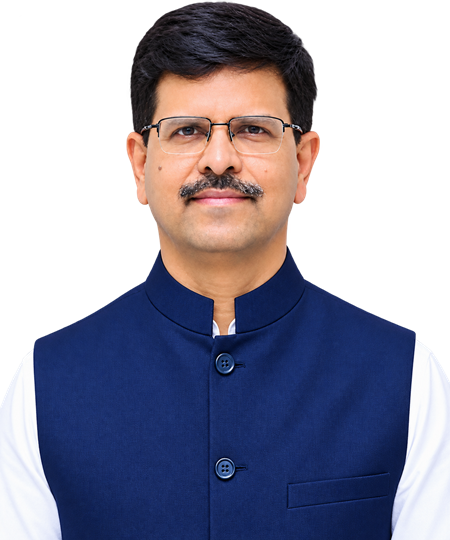
From stronger connectivity to cleaner energy, his additional charge comes at a defining moment for a port whose ambitions now extend beyond cargo.
By – Snigdha Mishra
A port’s annual report counts tonnes. Its influence reaches much further.
It touches the factory waiting for raw materials, the exporter working against a delivery deadline and the family whose livelihood depends on the movement of goods. For Odisha, Paradip is where these everyday economic realities meet the possibilities of global trade.
That is the wider responsibility accompanying Susanta Kumar Purohit’s additional charge as Chairperson of Paradip Port Authority. The 1996-batch Indian Railway Service of Electrical Engineers officer assumed the responsibility on September 1, 2026, while retaining his leadership of V.O. Chidambaranar Port Authority in Tamil Nadu. paradipport.gov.in
His arrival comes at an important stage in Paradip’s development. The port has an established cargo business, major modernisation commitments and an emerging role in clean-energy logistics. Its leadership challenge is to connect these ambitions with dependable operations and measurable public value.
The next chapter will be judged by how effectively growth moves beyond the waterfront.
An engineer’s experience, a wider administrative perspective
Purohit brings experience across engineering, infrastructure and government policy. His career includes assignments in Indian Railways, the Ministry of Power and the Government of Odisha. He also served as Joint Secretary in the Department of Chemicals and Petrochemicals.
According to Paradip Port Authority, the priorities under his additional charge include stronger infrastructure and connectivity, improved operational efficiency, modern cargo-handling facilities and sustainable port development. paradipport.gov.in
These responsibilities call for more than technical knowledge. A port depends on organisations that operate to different schedules and priorities: railways, shipping companies, customs, terminal operators, industrial customers and state agencies.
Purohit’s varied professional background is relevant to that coordination challenge. However, experience provides a foundation; the practical test lies in translating it into timely decisions and consistent execution.
Taking responsibility for an institution with momentum
Paradip’s growth story was already well underway before this leadership transition.
The port handled 156.45 million metric tonnes of cargo in FY2025–26, its highest annual throughput. It also reported a net surplus exceeding ₹2,000 crore for the first time.
Coastal cargo accounted for 65.81 million metric tonnes, or 42.06% of total traffic, highlighting Paradip’s importance to trade within India as well as overseas commerce. These are institutional achievements from the financial year preceding Purohit’s additional appointment. paradipport.gov.in
For the incoming leadership, that performance creates both an advantage and an expectation. The task is to protect operational strengths while preparing the port for changing customer requirements.
A strong starting point makes the next stage more demanding: customers expect reliability to improve alongside capacity.
Beyond deeper waters: making modernisation work
On August 21, 2026, before Purohit assumed additional charge, seven infrastructure projects worth ₹427.80 crore were inaugurated at Paradip. The package included an 18.5-metre deep-draft capability, intended to accommodate fully laden Capesize vessels in the inner harbour.
Concession agreements worth ₹1,580.36 crore were also signed for three mechanisation projects, supporting the port’s target of full berth mechanisation by 2030. Press Information Bureau
These commitments form part of the development programme his leadership must help carry forward.
Their significance is practical. Larger vessels and modern equipment can improve efficiency, but customers experience those gains through predictable turnaround times, dependable handling and smoother cargo movement.
The leadership opportunity is therefore to make individual investments work together. A deeper harbour, a modern berth and an efficient transport connection should reinforce one another.
The railway connection behind maritime growth
A ship’s arrival is only one part of a cargo journey. What happens before loading and after unloading matters just as much.
Purohit’s early engagements reflected that wider view. In September, he met Odisha Chief Secretary Anu Garg and other senior state officials to discuss development and institutional coordination. Separate discussions with East Coast Railway officials addressed connectivity, railway infrastructure and logistics. paradipport.gov.in
For an industrial state, these connections have consequences beyond the port gate. Businesses need confidence that raw materials will arrive and finished goods will move without avoidable disruption.
The value of maritime infrastructure depends on the strength of the network behind it.
This is also where leadership becomes less visible but especially important: resolving coordination gaps, aligning priorities and ensuring that expansion plans account for the entire cargo journey.
Preparing Paradip for the clean-energy economy
Paradip’s future also involves the cargoes and fuels of a changing energy system.
The government has recognised Paradip, V.O. Chidambaranar and Deendayal ports as Green Hydrogen Hubs. It has approved a green hydrogen and green ammonia handling jetty at Paradip through the public-private partnership model, with an estimated cost of ₹797.17 crore and a planned capacity of four million tonnes annually. This is an approved development project, not a statement that the facility is already operational. Press Information Bureau
Purohit’s responsibilities at both Paradip and V.O. Chidambaranar place him within two ports participating in that transition.
The opportunity extends beyond a new category of cargo. It requires the right infrastructure, trained personnel, safety arrangements and commercially viable demand.
For Paradip, the challenge is to prepare for emerging markets while continuing to serve the industries that depend on its existing operations.
A wider coastal role: the Puri cruise proposal
A fresh development adds another dimension to the authority’s responsibilities.
On November 3, 2026, Union Minister for Ports, Shipping and Waterways Sarbananda Sonowal announced that Paradip Port Authority and the Government of Odisha would develop the proposed Puri International Cruise Terminal, at an estimated cost of ₹1,500 crore. pib.gov.in
The proposal brings maritime infrastructure into closer conversation with Odisha’s tourism economy.
Its eventual value will depend on more than the terminal itself. Passenger connectivity, destination services, environmental planning and opportunities for local enterprises will shape the experience it offers.
For PPA, this broadens the leadership agenda—from facilitating industrial cargo to helping develop a different kind of coastal gateway.
Keeping people within the growth story
Ports are often discussed through investments, capacity and commercial performance. Yet every expansion also raises questions about the people who work within it and live around it.
As mechanisation advances, training and workplace safety deserve sustained attention. As new projects develop, local businesses and communities need credible opportunities to participate.
These are essential measures for assessing the next phase of Paradip’s development. They should sit alongside cargo statistics, rather than disappear beneath them.
A port’s progress becomes more meaningful when efficiency, safety and local opportunity advance together.
The responsibility of the next chapter
Purohit takes additional charge of a port with substantial institutional strengths and an ambitious development programme.
The priorities are interconnected: dependable cargo movement, stronger inland connections, execution of modernisation projects and readiness for new energy markets. The emerging cruise initiative adds another responsibility requiring careful coordination.
For Odisha, the significance of this leadership chapter will ultimately be found in outcomes: a more reliable gateway for industry, stronger links to markets and wider opportunities along the coast.
Paradip already moves an extraordinary volume of cargo. Its next challenge is to ensure that the benefits of that movement travel further.
