Subhechcha Ganguly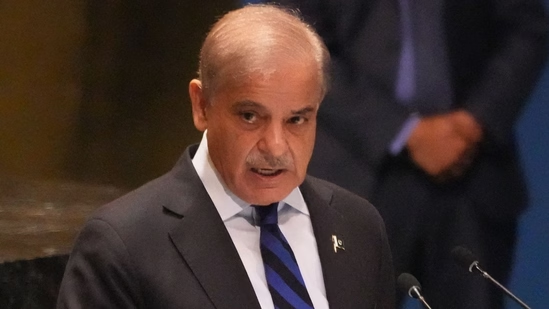
In a renewed escalation of rhetoric over the Indus Waters Treaty, Pakistani Prime Minister Shehbaz Sharif and Army Chief General Asim Munir have issued strong warnings to India, threatening retaliation if water flow to Pakistan is blocked.
Speaking at a ceremony in Islamabad on Tuesday, Sharif declared, “If you threaten to hold our water, keep in mind you cannot snatch even one drop from Pakistan.” He added that any attempt to restrict water flow would be met with a stern response, echoing Pakistan’s long-standing position that such a move would be treated as an act of war.
His statement came a day after former foreign minister Bilawal Bhutto-Zardari claimed that suspending the treaty would be an attack on the Indus Valley Civilisation. In response to Bhutto’s remarks, Indian actor and BJP leader Mithun Chakraborty delivered a fiery rebuttal, warning of a barrage of BrahMos missiles if provoked. He also made a bizarre comment about building a dam for symbolic retaliation, while clarifying that his criticism was directed at Pakistan’s establishment, not its people.
Meanwhile, addressing the Pakistani diaspora in Tampa, Florida, General Asim Munir threatened to destroy any dam India might build to control water flow. “The Indus River is not Indians’ family property. We have the resources to undo their designs,” he said.
India’s Ministry of External Affairs (MEA) swiftly hit back, condemning Munir’s remarks as another instance of Pakistan’s “nuclear sabre-rattling” and warning that New Delhi would not yield to “nuclear blackmail.” The MEA also expressed regret that such threats were issued from the territory of a “friendly third country,” in an apparent reference to the United States.
The tensions come just months after Operation Sindoor on May 7, in which India struck terror infrastructure in Pakistan and Pakistan-occupied Kashmir in retaliation for the April 22 Pahalgam attack that killed 26 civilians. Following days of cross-border drone and missile exchanges, both nations agreed to a ceasefire on May 10.
- ‘Intimidation or harassment’ may occur in India, the government of Canada cautions its people
- FIMI Hosts Successful ESG Conclave in Odisha Understanding ESG perspectives and navigating challenges
- Project Paper on Rural Administration
- Air India To Restore Employee Salaries To Pre-Covid Level From 1 September