

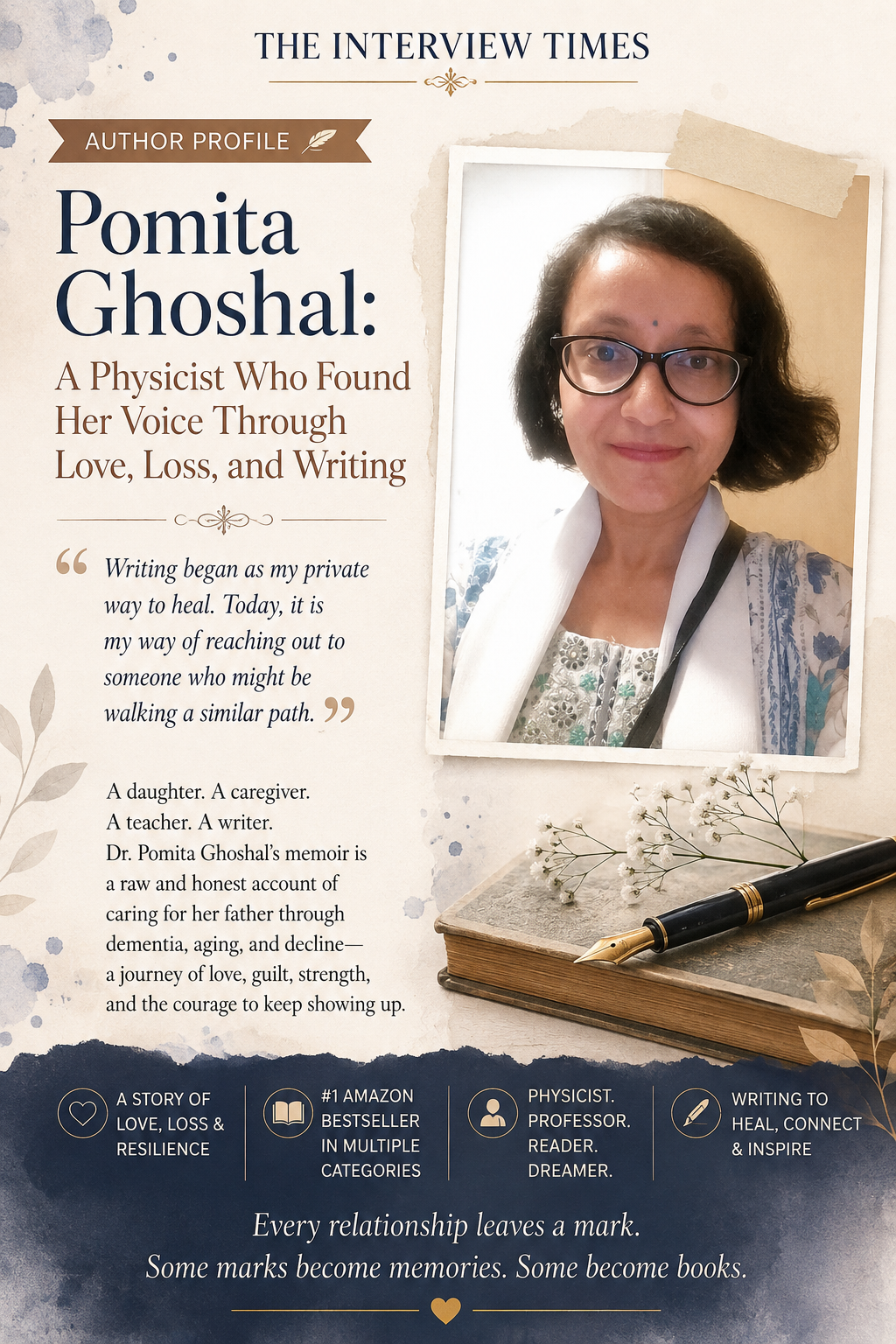
For Pomita Ghoshal, writing has always been more than just putting words on paper. It has been a way to understand life, make sense of difficult emotions and connect with people. A physicist by profession and a writer at heart, Pomita has carried her love for both science and literature throughout her life.
Born and brought up in Lucknow, Pomita was always fond of writing stories and articles during her school and college years. She did well in English language and literature and even had some of her work published in journals and magazines. Over the years, writing became a quiet part of her life. She wrote poetry, essays and articles, and later spent many years journalling her thoughts and emotions.
Her academic journey took her to several places. She completed her Ph.D. in Physics through HRI and Allahabad University and later pursued postdoctoral work at TIFR in Mumbai, SISSA in Trieste, Italy, and PRL in Ahmedabad. She is now an Assistant Professor of Physics at The LNMIIT in Jaipur and has published more than 20 research papers and articles in international Physics journals.
But beyond Physics, Pomita has always been deeply curious about people. She enjoys literature, psychology and understanding the complexities of human nature. Reading, writing, music and movies are an important part of her life, and she also enjoys Sudoku.
The biggest influence on her writing, however, came from her relationship with her father.
Pomita lost her mother when she was a child and grew up as an only child. Her father was her only family and her strongest emotional anchor. She lived with him throughout her life and shared a very close bond with him. When he grew older, she became his sole caregiver as he went through dementia, ageing and physical decline.
Her father passed away at the age of 97. The experience changed Pomita deeply. The years of caring for him were filled with love, tenderness and beautiful memories, but they were also filled with exhaustion, fear, frustration, guilt and uncertainty.
After his death, she found herself struggling with grief and many difficult questions. Like many caregivers, she wondered about all the things she could have done differently. Slowly, she realized that her story could perhaps help others who were going through something similar.
That is how her memoir, When I Became My Father’s Mother, came to life.
The book is a deeply personal story about what happens when a parent slowly begins to forget the child they have always known. It tells the story of a daughter who gradually becomes a caregiver and, in many ways, becomes the parent to the person who once cared for her.
But the book is not only about dementia or caregiving. It is also about love, grief, guilt, family and the complicated emotions that come with watching someone you love change. Pomita writes honestly about the difficult moments as well as the tenderness, humour and unexpected moments of grace that appeared along the way.
What makes her story especially meaningful is that she does not try to present caregiving as a perfect journey. She openly speaks about exhaustion, mistakes, regret and moments when she struggled to cope. At the same time, she believes that caring for her father became an act of love because of the relationship they had built over many years.
She hopes her book can remind caregivers that they are not alone. She also wants them to remember to take care of themselves and not be too hard on themselves when they feel overwhelmed. Her message is simple: caregiving is incredibly difficult, and even imperfect care can come from a place of deep love.
Her work has already begun to connect with readers. When I Became My Father’s Mother reached #1 on the Amazon India Bestseller list in Mind and Body Philosophy eBooks and #2 in Biographies and Autobiographies. The book also reached #1 in Amazon India’s Hot New Releases in these categories and in True Accounts.
Pomita has also received recognition for both her academic and literary work. She has won the India Authors Academy Author Award in June 2026 and the Sahitya Ratna Samman Award for Best Non-fiction Author in the Memoir category in July 2026.
Today, Pomita continues to balance her life as a teacher, researcher and writer. She believes that good writing comes from reading widely, observing life closely and having the courage to write honestly. For her, writing first began as a private way to heal. Now, it has become a way to reach out to others.
And she is not done writing yet.
Her next project may look beyond the story of her father and explore something much wider: how the way we are loved and raised shapes the people we become. She is interested in the idea that gentle, open and understanding parenting can create a ripple effect, helping people become more accepting, less judgmental and more connected to one another.
At the heart of Pomita Ghoshal’s journey is a simple idea—that love leaves a mark on us. Sometimes, that mark becomes a memory. Sometimes, it becomes a book. And sometimes, it becomes a story that helps someone else feel a little less alone.