
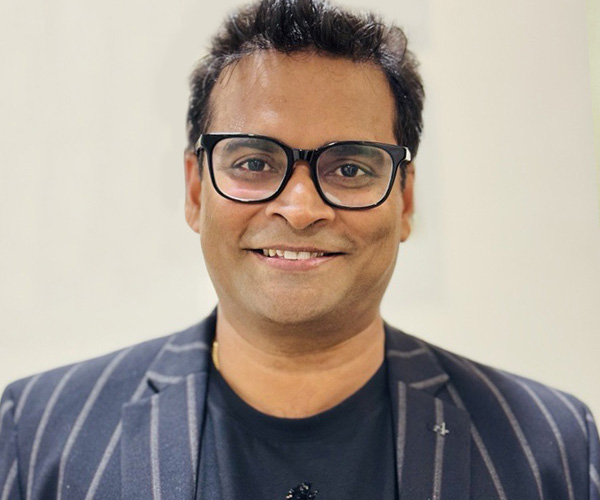

Inovaare’s co-founder and CTO on betting against giants, the loneliness of a first sale, and why he never wanted to leave Odisha in the first place
There is a particular kind of confidence that comes not from certainty, but from necessity. Mohar Manohar Mishra, co-founder and Chief Technology Officer of Inovaare Corporation, speaks with exactly that kind of confidence — measured, unhurried, occasionally surprised by his own questions. Ask him how he and his co-founder decided a niche healthcare compliance platform could compete with the likes of Google, Oracle, and Microsoft, and he doesn’t reach for a rehearsed founder’s-origin-story answer. Instead, he pushes back gently on the premise itself.
“It’s very difficult to pinpoint a particular spot,” he says. “These kinds of things happen, driven by a particular situation.”
That situation, as he describes it, was less a calculated market entry and more a convergence of timing, temperament, and an old, stubborn loyalty to healthcare as a sector worth solving. Mishra and his co-founder were both repeat entrepreneurs — this wasn’t their first venture — and both were drawn to healthcare specifically because of its outsized real-world stakes. “When you do something good, you reduce the cost — whether it’s for an insurance company, a member, or a hospital — it finally impacts the common man in a positive manner,” he says. It is, in his words, “a very serious job,” layered with regulation, security requirements, and complexity that most industries simply don’t carry.
Crucially, the two founders had something else most first-time entrepreneurs lack: domain expertise and a network that surfaced real use cases early. “We got into a situation where we had a lot of healthcare use cases to be solved,” Mishra recalls. He’s quick to attribute some of it to chance — “you can call it destiny” — but the deeper pattern in his account is discipline, not luck. From the outset, the founders made a deliberate bet to stay narrow. They could have chased opportunities in energy, retail, or telecom. They didn’t.
“We made sure we don’t look at anything else,” he says. “If we get into one business area which we believe has enough revenue, enough prospects — it is better to focus in that area and become the best in the market, rather than looking at many other areas.”
The Hardest Sale Is the First One
Today, Inovaare runs centers in Bangalore and the United States, with every team member structured as a direct employee rather than through partner arrangements — a deliberate choice, Mishra notes, even as the company works with technology partners on implementation. But the company’s early footing in the competitive US healthcare market was anything but smooth.
“Getting your first customer is always the hardest,” he says, and the reasoning he offers is instructive for any founder coming out of the corporate world, as he and his partner did — both having spent years inside large multinationals before striking out on their own. “When you’re an established company, the customers know you, you know them, there’s a relationship already built. You come up with a presentation, you present it to the board, you get the deal.” A first-time venture has none of that scaffolding. “The presentations, the spreadsheets — those things do not work. You need to have the product there. You need to act as if you have experience, even when you don’t. That can only be done through sheer work. Nothing else.”
What “Big Data” Actually Means Inside a Hospital
Inovaare’s pitch centers on a cloud-based, big-data-analytics platform — language that, in less careful hands, could easily become buzzword filler. Mishra resists that temptation, instead grounding the concept in the lived reality of how American hospitals and health plans actually operate.
He draws a vivid comparison: banks once ran on people, paper, desks, and ledgers; today, that infrastructure has been replaced by systems. Healthcare went through a similar transition, except far less cleanly. “Every health plan we work with, every hospital we work with — they’re all 30, 40, 50 years old,” he says. “They’ve accumulated a lot of systems through a lot of vendors over a period of time.” Each system stores data differently, in different formats, maintained by different teams.
The problem, as Mishra frames it, is one of executive blindness. “Suppose you are the CEO of the organization. You cannot take all your decisions based on financial data. You cannot take all decisions based on technical data. You need to get the data from everybody, collect it, bring it together.” Inovaare’s cloud platform exists to do precisely that: centralize information from disparate hospital systems into one secure, standardized space — at a scale large enough that “big data” stops being a marketing term and starts being a literal description. “That becomes the foundation for everything we do next,” he says.
That foundation is what allows the company to operate in some of healthcare’s highest-stakes corners — sepsis, stroke, and oncology care, the areas where Inovaare first built its reputation. Mishra explains the logic plainly: these conditions demand intensive post-discharge follow-up, the kind hospitals often struggle to deliver consistently. “After the patient is discharged, there has to be post-discharge care,” he says — follow-up meetings, checkups, calls from nurses and doctors checking on recovery. “Hospitals were actually struggling to follow up and provide that care post-discharge. That is where we started.”
Scalability, in Mishra’s telling, isn’t an abstract engineering virtue either — it’s survival in a market where client size varies wildly. “One organization that’s bought our system might have only five employees. The same software might be bought by another organization with 50,000 employees,” he says. “You’re handling five megabytes of data today; tomorrow you’ll be handling five terabytes. It should still be working.”
Building US-Grade Compliance From Bhubaneswar

Inovaare’s India development center sits in Bhubaneswar, operating under the same federal regulatory bar that governs healthcare data handling in the United States. Asked about the technical and operational challenges of meeting that standard from Odisha, Mishra is almost dismissive of the framing — not because the standards are trivial, but because, in his view, geography isn’t the variable that matters.
“Odisha doesn’t pose any particular challenge,” he says. “If you are doing anything outside the US — whether it’s India, Europe, Australia, Singapore — it doesn’t make a difference. This is about being very honest and very sincere with your effort. These things are all nicely documented. With the documentation available, and implemented properly, you follow the rules that exist.”
It’s a quietly significant claim: that India, and Odisha specifically, isn’t a workaround or a discount alternative to Silicon Valley delivery, but a fully capable peer once the discipline of compliance is taken seriously.
What Bhubaneswar Still Needs
That said, Mishra doesn’t romanticize the state’s tech ecosystem uncritically. Asked what Indian tech hubs like Bhubaneswar still need to compete globally, he points to infrastructure and quality of life as the binding constraint — not talent. “From a fresh graduate perspective, I don’t think there’s any problem,” he says. “But in terms of experienced people, most talent today is going to Bangalore, Hyderabad — those kinds of places.”
The reason, he argues, is livability: better housing, schooling, healthcare. “It’s getting developed, slowly, but we have to develop it further, so that people are willing to settle down” in Odisha rather than simply working there before relocating. He notes a regional asymmetry with some irony — Odisha residents often see settling in Bangalore or Mumbai as a marker of success, while the reverse migration rarely happens. “The same thing the South Indian people should also see,” he says, only half-joking.
Culture as Strategy
With more than 300 engineers, data scientists, and associates now at Inovaare, retention is as much a strategic question as recruitment. Mishra’s answer leans less on perks and more on a philosophy of radical transparency. “We do not have any other standard,” he says. “We have a very open culture, like a family culture.” Compensation is benchmarked to industry standards, the client roster and technology stack are positioned as genuinely competitive, and the company’s implicit deal with its people is unusually candid: stay if Inovaare offers more than the market does; leave if it doesn’t.
“If they really get a better opportunity than what we are providing, we believe they should grow — and they should grow in their career,” he says. “If our opportunities are better than the market, they should stay with us. We’re extremely transparent in that philosophy, and that works for us.”
From Puri to Bangalore to the Bay Area — and Back
Mishra’s own path runs through a bachelor’s degree in physics from Ravenshaw College, a master’s from BITS Pilani (referred to in conversation as MSc), and a decade-long career at HP before he became an entrepreneur. He’s candid that entrepreneurship wasn’t a long-held calling. “It was certainly not the case that I wanted to be an entrepreneur,” he says of his time at HP in Bangalore, where, by his own account, things were going well — he was only 31 when he left in 2009.
What pulled him away wasn’t dissatisfaction with the work itself but a deeper pull toward home. “I’m from Puri. I have my family, extended family, a lot of things, and I love my place,” he says. “Settling down [in the US] was not a good idea for me. I could have settled in the US, or multiple other places, but I was very particular about coming back.” At the same time, the corporate roles available to him weren’t satisfying his “intellectual thirst” — a tension that, combined with an invitation to join a startup venture, set the entrepreneurial path in motion. “Necessity is the mother of all inventions,” he says of the convergence. “When multiple things happen at the same time — that’s luck.”
He describes the choice, more than a decade on, as one of his best. “Very much” satisfied, he says, without hesitation.
A Partnership Built on Looseness, Not Closeness
Asked what he looks for in a co-founder, and what’s made his decade-long partnership endure, Mishra reaches for an engineering metaphor rather than a sentimental one — fitting, for a CTO. “There’s a phrase: loosely coupled but highly cohesive,” he says. He and his co-founder didn’t know each other before the venture; they met, as he puts it, by a fortunate accident. The partnership works, he argues, precisely because neither depends on the other for basic function. “Loosely coupled means I can do everything without the other’s help. I don’t need somebody’s help to survive. But when you take help, you become cohesive — you become part of his team, and he becomes part of my system, when needed.”
The operational split is similarly clean: Mishra, based in Bhubaneswar, owns technology, design, and engineering; his co-founder, based in the US, owns customers, sales, and the commercial relationship. Two distinct halves of one company, each trusted to run independently.
The Flute Player Behind the CTO
Away from compliance frameworks and cloud architecture, Mishra has a parallel identity that surprises most people who only know him through his technology credentials: he is a trained Hindustani classical flautist, performing since the age of eight or nine. “I’m a professional classical performer,” he says, noting he also sings and plays guitar. As a child, he briefly entertained the idea of pursuing music professionally — “but I was also reasonably good at studies, so that thought was not entertaining” — though he’s maintained the practice ever since, performing at community functions and sharing his music on Instagram.
He’s also, by his own cheerful admission, a committed cricket enthusiast, playing on a team that has “all the trophies.” Asked whether his closely tracked interest in Indian and global politics shapes his thinking on healthcare policy, he draws a clear line: it doesn’t, professionally. “It has nothing to do with my business,” he says. “It’s a personal thing” — though one he considers important, rooted in a lifelong curiosity about the machinery of governance and policymaking rather than news-cycle commentary.
It’s a fitting closing note for a profile built around precision and boundary-setting: a technologist who has spent a decade building systems to bring order to healthcare’s most fragmented data, and who applies much the same discipline to keeping his professional convictions and personal passions distinctly, deliberately separate.
