
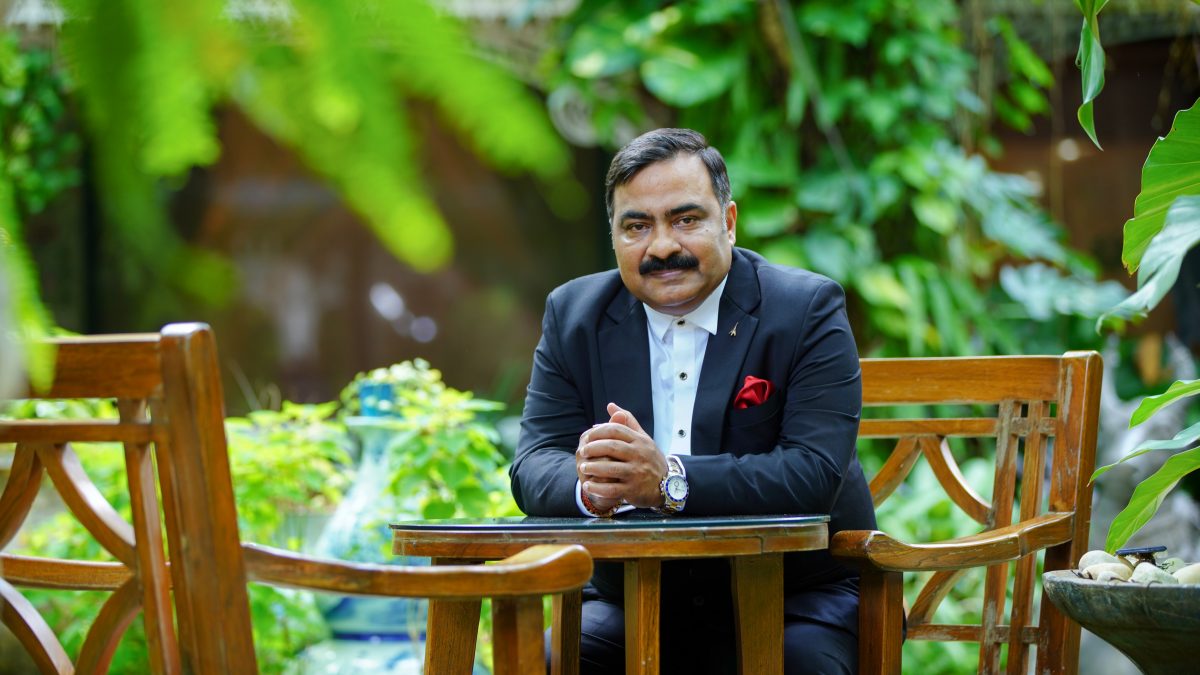
Dr. Souvagya Mohapatra: Building Hospitality, Shaping Policy, Reimagining Odisha
Few figures in Indian hospitality command the kind of institutional authority and lived experience that Dr. Souvagya Mohapatra does. In 2021, he stepped into one of the most ambitious roles of his career as Managing Director for India, Bhutan, Nepal, and Sri Lanka at Atmosphere Core where he was tasked with translating an Indian Ocean-born luxury ethos into the South Asian growth story.
With over three decades in the industry, his career has run parallel to the evolution of India’s luxury hospitality landscape. From his early years at The Oberoi Group to his rise at Mayfair Hotels & Resorts—where he scaled from operations to the Executive Director’s office—Mohapatra has helped shape not just organizations, but regions.
Recognition has followed impact. In November 2025, he was conferred an honorary Ph.D. in Hospitality and Tourism by ICFAI University, Gangtok. He has also been a consistent presence on Hotelier India’s Power List and an active voice on industry juries and policy platforms.
Today, his influence extends beyond business: Chairman of FICCI’s Eastern Region Tourism Committee, Co-Chair at CII, Executive Committee Member at FHRAI, and a key academic contributor at IHM Bhubaneswar.
In this conversation with The Interview Times, Dr. Mohapatra reflects on legacy, leadership, and the future of hospitality.
After three decades in the industry, what does an honorary doctorate mean to you?
At a certain point in one’s career, recognition moves beyond achievement into meaning. For those in public life, honours like the Padma awards mark that moment. For someone in hospitality, a doctorate carries a similar weight—it is a validation of sustained contribution.
I see it not as a culmination, but as a milestone in an ongoing journey.
You’ve worked at the intersection of business and policy. How do the two reinforce each other?
Policy divorced from ground reality rarely works. The advantage of coming from the field is clarity—you already understand the operational gaps, the friction points, the missed opportunities.
That practical lens allows you to contribute to policymaking with precision rather than theory. In hospitality, that alignment is essential.
Your recent meeting with the Honourable Chief Minister of Odisha—what was at the top of the agenda?
The conversation was focused and forward-looking. I shared progress on PRATYAKSH – an Atmosphere Experience, Chandragiri, a five-star eco-resort project near Lirang Monastery, where construction is already underway with international design collaboration.
We also discussed a pipeline of developments across Bhubaneswar, Konark, and Brahmagiri–Puri—particularly around land facilitation and accelerating project timelines. The intent is clear: move from vision to execution.
Your role has shifted significantly in recent years. How does this redefine your legacy?
Before 2021, I operated at a macro level—overseeing systems, structures, and scale within an established organization.
Today, the shift is far more personal and entrepreneurial. It’s about building, not just managing. The lens is narrower, the involvement deeper, and the accountability immediate. That changes how you look at impact—and legacy.

You’ve been part of conversations on sustainable hospitality. Is net-zero still aspirational or operational?
It has to be operational. At Atmosphere Core, our Maldives properties are Green Globe certified, which sets a global benchmark for sustainable practices.
But the real challenge lies in implementation—how do you optimize energy and water usage across core functions like HVAC, kitchens, and laundry without diluting guest experience?
These are not theoretical debates anymore. The industry is already solving them in real time.
What has remained constant in your work ethic?
Three things: passion, drive, and humility.
The industry evolves, roles change, but these constants keep you grounded. Add to that a conscious commitment to stay positive, and you build resilience over time.
What have you tried to stand for in industry associations?
Clarity of purpose. Every association must answer one question: how does this improve the industry from within?
For me, that has meant focusing on knowledge dissemination—ensuring learning is democratized—and enabling hotel owners to stay informed and future-ready.
Associations should function as bridges, not clubs.
How has hospitality shaped you personally?
It has been my greatest teacher. Everything I understand about people, systems, and resilience comes from this industry.
What stays with you is the realization that learning is not finite. If you remain open, every interaction—regardless of hierarchy—adds value.
Your advice to young professionals entering hospitality today?
Stop waiting. Start doing.
Opportunities do not arrive fully formed—you step into them, often unprepared, and grow through the challenge. Equally, develop the discipline to listen. Authority comes not from speaking more, but from understanding better.
Observe, absorb, and then contribute.
How do you see Odisha’s hospitality future evolving?
Odisha is at an inflection point. The narrative has shifted from being the ‘Best Kept Secret’ to a confident ‘Think India, Think Odisha.’
The state has a rare geographic advantage—it offers diversity across landscapes and experiences. What it needs now is execution: infrastructure, innovative attractions, and strong storytelling.
The opportunity is immense—not just for tourism, but for employment and economic transformation. The next phase will depend on how effectively ideas are translated into action.
Dr. Mohapatra speaks with the clarity of someone who has seen the industry evolve from the inside—and continues to shape its future.As Odisha positions itself for a tourism-led transformation, voices like his will not just guide the conversation—they will define it.
