
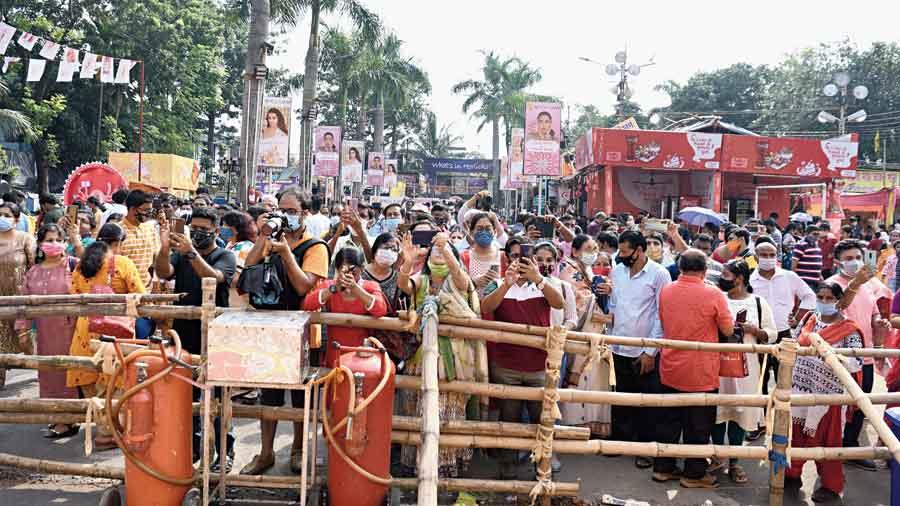
At least 19 people have died and 25 others have been injured following a stampede at the Chorbagan Sarbojanin Durga Puja pandal in north Kolkata on Saturday evening, 17 October. The West Bengal government has announced a special investigation team headed by a sitting Calcutta High Court judge to examine the circumstances surrounding the tragedy.
The incident has raised urgent questions about crowd management, emergency access and safety arrangements at large religious gatherings. Authorities are examining CCTV footage and questioning people involved in organising and securing the event.
What happened at the pandal?
The stampede occurred at the popular north Kolkata venue during Maha Saptami, one of the major days of Durga Puja celebrations. According to reports, the incident took place at approximately 7:30 p.m., when a large crowd had gathered in the area.
Heavy rain and congestion in the narrow lanes around the pandal appear to have contributed to the dangerous situation. Witness accounts and preliminary reports indicate that people attempted to move through the crowded area, leading to falls and a sudden surge of people.
Authorities are still investigating the precise sequence of events. The available information does not establish a final cause or determine who, if anyone, was responsible for safety failures.
Investigation launched into possible safety lapses
The state government has announced that a special investigation team will examine the incident, with a sitting judge of the Calcutta High Court expected to head the inquiry.
The investigation is expected to consider crowd-control arrangements, the management of entry and exit points, the deployment of police and private security personnel, and the response to the rapidly worsening situation.
Police have detained and questioned individuals connected with the event, including members of the organising committee and security personnel. CCTV footage has also been collected for examination.
These detentions are part of the investigation and do not, by themselves, establish guilt. The inquiry will need to determine whether any negligence or procedural failures contributed to the loss of life.
Government announces compensation and assistance
West Bengal Chief Minister Suvendu Adhikari has announced compensation of ₹25 lakh and a government job for the family of each person who died. The state has also announced ₹5 lakh for each injured person and said it will cover their medical expenses.
Prime Minister Narendra Modi has separately announced assistance from the Prime Minister’s National Relief Fund of ₹2 lakh for the next of kin of each deceased person and ₹50,000 for those injured.
These measures are intended to provide immediate support to affected families, although financial assistance cannot compensate for the scale of the personal loss.
Other pandals face safety scrutiny
The tragedy has prompted authorities to take additional precautions at crowded Durga Puja venues. The Chorbagan pandal was closed following the incident, and police advised other heavily visited pandals to temporarily restrict entry where necessary.
Kolkata has thousands of Durga Puja pandals, many of which attract large crowds during the festival. Temporary structures, narrow approach roads, changing weather conditions and high visitor numbers can make crowd management particularly challenging.
Authorities must ensure that emergency exits remain accessible, crowd movement is monitored and entry is controlled when venues approach their safe capacity. Clear announcements and coordination between organisers, police, volunteers and emergency services can also be crucial in preventing dangerous surges.
The incident has renewed the debate over whether crowd-control arrangements at major festivals are sufficiently robust to cope with peak attendance and sudden emergencies.
A wider lesson on public-event safety
The tragedy is a reminder that successful festival planning requires more than elaborate decorations and large-scale public participation. Safety arrangements must be central to the planning process, particularly at venues with restricted access or limited space.
The investigation will be important in establishing the facts and identifying any accountability. Its findings may also help inform safety requirements for other large public gatherings in West Bengal and beyond.
As the inquiry proceeds, the immediate priorities remain supporting affected families, ensuring medical care for the injured and preventing similar incidents at other crowded venues.
Sources
