
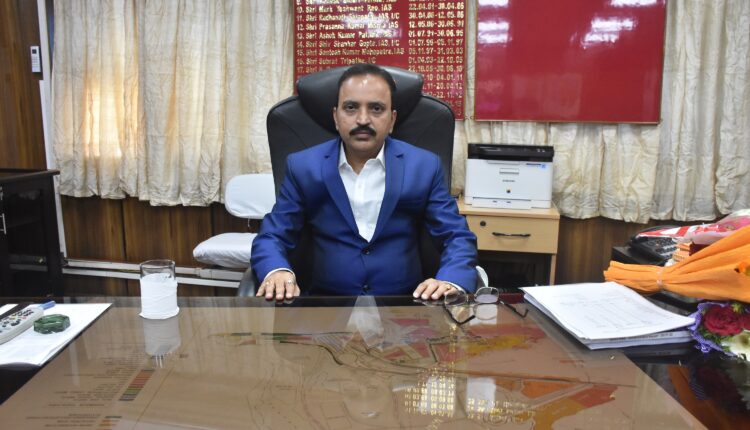
At Paradip Port, where the sea never rests and ships arrive carrying the promise of progress, leadership is not always loud—but it is always steady.
Meet Sri P. L. Haranadh, IRTS, Chairman of the Paradip Port Authority (PPA), the quiet force driving the port’s precision, performance, and purpose. With decades of experience across India’s transportation network, he stands at the helm of one of the nation’s most strategic maritime gateways, guiding it toward sustained excellence.
From Rail Tracks to Maritime Leadership
Haranadh’s journey began not on the waters, but along India’s railway tracks. A 1994-batch officer of the Indian Railway Traffic Service (IRTS), he built a distinguished career in Indian Railways, developing deep expertise in freight operations and transportation systems.
Academically accomplished, he holds an MSc and a Ph.D. from the Indian Agricultural Research Institute (IARI), Pusa, New Delhi—an academic foundation that sharpened his analytical thinking and administrative acumen.
Over 27 years of service in Indian Railways, he held several key positions, including:
Senior Divisional Operations Manager across multiple divisions
Deputy Chief Operations Manager in South Eastern and South Central Railways
Chief Operations Manager (Marketing), East Coast Railway
This extensive exposure to operational coordination, freight logistics, and stakeholder engagement uniquely prepared him for leadership across transportation modes.
Before taking charge at Paradip, he served as Deputy Chairman of Visakhapatnam Port Authority, where he played a crucial role in attracting new cargo streams and strengthening operational growth.
Taking Charge at Paradip Port Authority
When Haranadh assumed leadership at Paradip Port Authority, he set a clear and ambitious vision: to elevate Paradip to the position of India’s No. 1 Major Port.
His approach was rooted in collective ownership. He actively engaged employees, trade unions, port users, stevedores, shipping agents, and government stakeholders—fostering unity toward a shared goal.
With its strategic coastal location, ideally suited for bulk and project cargo, Paradip Port has always been a vital node in India’s maritime network. Under his leadership, this inherent potential has been fully harnessed through infrastructure modernization, process optimization, and a strong commitment to sustainability.
Growth and Operational Excellence
Under his stewardship, Paradip Port Authority has broken record after record, transforming into one of India’s most efficient and high-performing major ports.
Key Achievements:
Highest-ever annual cargo throughput of 150.41 million metric tonnes (MMT) in FY 2024–25, surpassing the previous record of 145.38 MMT and registering a growth of 3.46%.
Emerged as the No. 1 Major Port in India in terms of cargo volume, rising from its previous second position since inception.
These milestones reflect not just rising cargo volumes, but also enhanced berth productivity, faster vessel turnaround times, improved evacuation systems, and stronger multimodal connectivity.
This achievement marks a significant shift in India’s maritime landscape, reinforcing Paradip’s position as a critical trade gateway for bulk commodities, industrial inputs, and coastal shipping.
Building for the Future: Infrastructure and Expansion
Haranadh’s vision extends far beyond operational targets. He has laid out a robust roadmap to expand Paradip Port’s long-term capacity and competitiveness.
A cornerstone of this expansion is the Western Dock Project, which will enable Paradip to handle fully laden capesize vessels. Progressing ahead of schedule, the project is expected to increase the port’s capacity to over 300 million metric tonnes annually by early 2026.
Looking ahead, the port aims to achieve:
350 MMT capacity by 2030
Greater berth mechanization
Comprehensive digital transformation across port operations
These initiatives are designed to future-proof the port and align it with global maritime standards.
Green Ports and Sustainability Initiatives
Under Haranadh’s leadership, sustainability has become central to Paradip Port’s evolution.
Paradip Port has been recognized as a Green Hydrogen Hub under the National Green Hydrogen Mission, positioning it to support large-scale hydrogen production, storage, and export in line with India’s clean energy ambitions.
To further advance its environmental agenda, the port is:
Installing a 10 MW solar power plant
Expanding renewable energy adoption across operations
Implementing emission reduction strategies
These initiatives reflect a leadership philosophy that sees infrastructure not merely as an economic asset, but as a vehicle for sustainable development.
A Port Connected to Its People
Haranadh’s vision extends beyond cargo and steel—he places equal emphasis on people and community.
He has championed employee welfare, cultural integration, and community participation. Events such as the All India Major Port Cultural Meet highlight his belief that port institutions and coastal communities must grow together, fostering shared pride and unity.
In recognition of its outstanding performance in cleanliness, sustainability, and community engagement, Paradip Port Authority was awarded First Prize at the Swachhata Pakhwada Awards 2025, instituted by the Ministry of Ports, Shipping and Waterways (MoPSW).
Large-scale cleanliness drives and environmental awareness campaigns further reinforce PPA’s commitment to responsible and inclusive growth.
A Vision Anchored in Collaboration and Commitment
Sri P. L. Haranadh’s leadership at Paradip Port Authority is defined by strategic foresight, operational discipline, and a deeply collaborative spirit.
His background in railway logistics provides him with a unique understanding of complex transportation networks—an advantage he leverages to strengthen multimodal integration and efficiency at Paradip.
Under his guidance, Paradip Port Authority has not only broken records but also established new benchmarks in growth, sustainability, and infrastructure development.
It is a testament to a leader who believes that great institutions are not built by individuals alone—but through shared purpose, disciplined execution, and relentless innovation.
