Subhechcha Ganguly
Meet Sreeja Raman, a seasoned freelance writer whose literary journey began at a tender age. With her first poem published in a children’s magazine at just five or six, she embarked on a creative writing path that has culminated in multiple published works. Sreeja’s latest endeavour, “In Search of Philosia – Decoding an Indian Festival,” is a 388-page exploration of the Indian festival Thrissur Pooram, unravelling the enigma surrounding traditional events and Indian heritage.
Questionnaire:
- What inspired you to delve into creative writing at such a young age, leading to your first published poem in a children’s magazine?
Ans. Perhaps it’s an inherited trait. Many people in my maternal and paternal families were creative writers, though nobody ever made a big deal out of it. My father has also been a literary enthusiast. While cradling me in his arms, I recall my father reading aloud many classic poems to me and then explaining what they meant, appreciating the vivid imagery, and other literary tactics. Even before I learned to read and write, I had poetry floating around in my thoughts.
- Can you elaborate on the significance of the title “In Search of Philosia” and how it relates to decoding the Indian festival Thrissur Pooram?
Ans. Indeed, this book is all about decoding a festival that has all the traditional traits of India. Traditional traits are directly proportional to culture, as we all know. Most cultures have their own geographical territories, called countries. India, a country that has seen its borders redrawn multiple times, undoubtedly has a lot to say regarding its alarmingly diverse traditions. Therefore, to decode anything traditional in India, we need to go deep into its heritage, which we find closely linked to its philosophical tenets, the Philosia.
- In your book, you mention that traditional events and Indian heritage are often misunderstood. How do you strive to demystify these aspects for your readers?
Ans. India has frequently been described as a mystic, mysterious, and incredible land. On a personal level, I disagree with this formula. When something is difficult to comprehend, it is common to arrive at conclusions using such adjectives. Also, people have a tendency to generalise everything about India—its people, culture, religion, etc.—based on the impressions they get from literature or the media, which aren’t necessarily accurate or up-to-date. Indeed, people who haven’t explored this land beyond its routine hotspots may find it challenging to understand its sum and substance. This exploration must be done on one’s own because India is a land of seekers, not believers.
With this book, all I’ve attempted is to encourage the readers to discover for themselves how credible and profound India is beyond its “incredible” lustre.
- Thrissur Pooram is described as a not-so-ancient ritualistic festival. How does it serve as a gateway to discussing the profound concept of Philosia in your narrative?
Ans. As you noted, the concept of Philosia is truly profound since it beautifully encompasses the rich philosophical traditions of India, blending both idealistic and practical elements. Spirituality is at the centre of all these various concepts, and it is explored as a progression from practicality to profundity rather than just a straight dive into spirituality. It could therefore be considered religious in terms of this conduct. Needless to say, the essence of the religion is expressed through rituals, many of which are recurring in nature. Thus, with the many practical steps, every ritual and festival becomes a prelude to the profound spirituality that Philosia delves into. Thrissur Pooram has rather less ritualistic content, yet it does have an indirect role in passing on the messages of Philosia.
- Your book explores the deep and diverse nature of the Indian psyche through rituals, worship, and festivals. How do you convey the essence of this spiritual quest to your readers?
Ans. First of all, let me say that this book doesn’t explore that profundity very much. As I mentioned before, this exploration must be done on one’s own because India is a land of seekers, not believers. What I’m doing here is just setting up a launching pad for those who are interested in exploring more, rather than just gulping down what others have handed them on a silver platter.
- Receiving appreciation from Dr. Shashi Tharoor is a notable achievement. Could you share more about his feedback and its impact on the second edition of your non-fiction narrative?
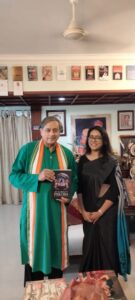
Ans. As an aspiring Indian-English writer, I consider it a blessing that I have received positive feedback about my book from a man I have always looked up to. Aside from being a diplomat and a wordsmith, he is also a person of integrity. Sources close to him told me that he would not say anything about a book unless he finished reading it from cover to cover. Thereby, it took him two months to finish reading my book before writing a note of appreciation.
As I watch now, I believe that this note will certainly take my book to the stars.