
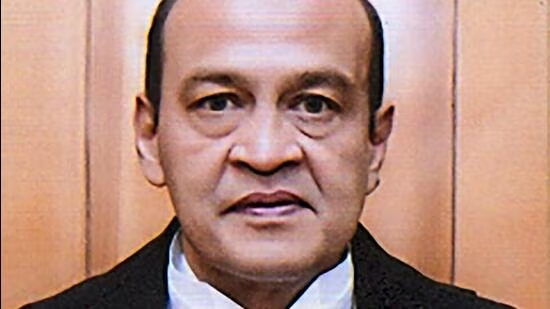
Senior advocate Kapil Sibal, representing Justice Yashwant Varma, on Wednesday requested an urgent hearing before the Chief Justice of India (CJI) Bhushan R Gavai, urging early listing of a plea challenging the findings of an in-house inquiry committee. The panel had alleged “strong inferential evidence” linking the sitting judge to charred currency notes found at his official residence in Delhi earlier this year.
CJI Gavai acknowledged the gravity of the constitutional issues involved but recused himself from hearing the case, citing prior involvement in internal discussions. He assured that a separate bench would be constituted to hear the petition.
Justice Varma, who has returned to the Allahabad High Court, filed a writ petition on July 17 against the May 3 report by the Supreme Court-appointed panel and the subsequent May 8 recommendation by then CJI Sanjiv Khanna for impeachment proceedings.
The judge termed the panel’s report “unsustainable,” alleging that the process violated principles of natural justice and was guided by a “preconceived narrative.” His petition questioned the lack of investigation into key facts, including the ownership and recovery details of the charred cash allegedly found after a fire broke out at his Delhi residence on March 14.
The development comes amid a political push to remove Justice Varma through impeachment. On July 21, the opening day of the monsoon session of Parliament, 145 Lok Sabha and 63 Rajya Sabha members submitted separate notices seeking his removal.
Justice Varma has maintained his innocence, arguing that no direct evidence ties him to the recovered money. He claims the committee reversed the burden of proof and operated with an outcome-driven mindset. In his response to the inquiry, he labeled the allegations as part of a “conspiracy.”
Earlier reports indicated that he had declined suggestions by the then CJI to resign or opt for voluntary retirement, asserting that the panel’s approach undermined constitutional safeguards for sitting judges.
The in-house panel, comprising Chief Justices Sheel Nagu, GS Sandhawalia, and Justice Anu Sivaraman, had concluded that the presence of currency notes in his residence—even without direct involvement—was enough to warrant proceedings for judicial misconduct.
The Supreme Court is now expected to set up a new bench to hear the matter and determine whether the inquiry report can be legally quashed.
