
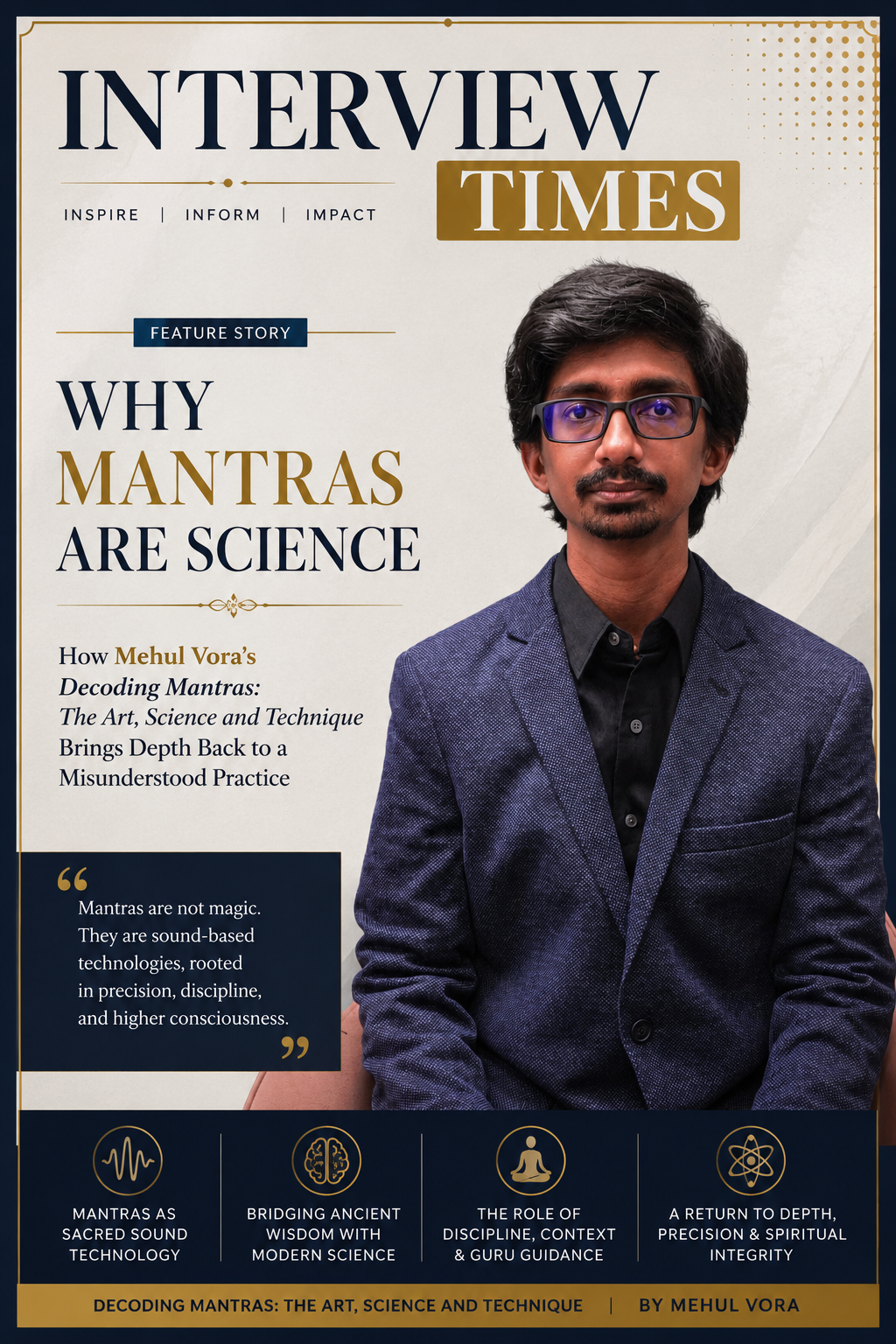
At a time when ancient spiritual traditions are increasingly reduced to short social media clips, viral trends, or simplified affirmations, Mehul Vora’s latest book, Decoding Mantras: The Art, Science and Technique, offers a refreshing and thoughtful perspective. Rather than promoting quick solutions, the book encourages readers to reflect on a deeper question: Have we truly understood the authentic practice of mantra chanting, or have we unintentionally oversimplified one of the world’s oldest spiritual sciences?
A research scholar focused on Ancient Indian Knowledge Systems (IKS), Mehul Vora is known for presenting complex spiritual subjects with clarity, balance, and scholarly insight. His earlier books, including Secret Goddesses of Tantra, which explores Tantra and the Dasha Mahavidyas, and Why Are We Here, reflect his commitment to making profound philosophical ideas accessible while preserving their original depth and authenticity.
Today, mantras are commonly shared through podcasts, social media reels, messaging platforms, and everyday conversations. While this widespread availability has introduced more people to the practice, it has also led to a gradual loss of its traditional context. What was once a disciplined, guru-guided path rooted in Vedic and Tantric wisdom is often reduced to repetitive chanting intended primarily for fulfilling personal desires. Instead of promising instant results or mystical shortcuts, Mehul Vora’s book advocates for precision, discipline, context, and responsible practice.
Mantras as a Structured Science of Sound
According to the traditional interpretation, a mantra is “that which liberates the mind” (“mana-trayate iti mantrah”), helping an individual transcend worldly limitations and move toward spiritual freedom. Classical scriptures describe mantras as carefully structured combinations of sacred syllables (varṇas) that embody Śabda-Brahman, the divine principle of sound. These sacred vibrations are regarded as living energies capable of awakening consciousness, activating mantra-śakti (inner spiritual power), and guiding the practitioner (sādhaka) toward higher awareness, siddhis (spiritual attainments), and ultimately jīvanmukti, or liberation while living.
The book stresses that the effectiveness of a mantra depends on precision. Even small errors in pronunciation, rhythm, or intention may influence its outcome. Authentic mantra practice includes disciplines such as japa (repetition), nyāsa (placing sacred syllables on the body), sādhanā (dedicated spiritual practice), dīkṣā (initiation), and purification. Mehul Vora compares a mantra to a seed that flourishes only when nurtured with the proper conditions—discipline serving as the soil, awareness as the water, and guidance from a guru as the sunlight. Without these essential elements, the practice may produce inconsistent or even counterproductive results.
Connecting Ancient Knowledge with Modern Science
One of the book’s central themes is the presentation of mantras as a sophisticated sound-based technology rather than an act of blind faith. Sound is a form of energy, and modern science recognizes that vibrations can influence matter, whether through resonance in engineering or the biological effects of acoustic waves. Mehul Vora explains that mantras function as carefully designed vibrational patterns capable of directing subtle energies, much like specific frequencies create measurable outcomes within physical systems.
From a biological standpoint, the human body—which is composed of approximately 60–70% water—is naturally responsive to sound vibrations. Chanting may influence cellular function, neurological activity, and emotional balance. The book refers to several peer-reviewed scientific findings that support these observations:
- EEG studies have found that chanting mantras, including the Mahā Mantra, increases relative alpha-wave activity in central and parietal regions of the brain, promoting relaxed alertness, lower anxiety, and improved mental well-being.
- MRI and other neuroimaging research suggests that chanting “Om” (AUM) reduces activity in limbic brain regions associated with fear and stress while encouraging calming alpha and theta brainwave patterns.
- Scientific studies also indicate that mantra practices may lower cortisol levels, reduce heart and breathing rates, improve heart rate variability, and strengthen parasympathetic nervous system activity, supporting recovery, concentration, and emotional resilience.
The book further explains that different mantras possess unique vibrational characteristics designed for specific purposes. Some are intended to calm the mind, while others help energize particular faculties or harmonize internal systems. This reflects the broader scientific principle that precise input produces reliable output. Incorrect pronunciation, poor concentration, or lack of proper context can significantly reduce the effectiveness of a mantra, much like inaccuracies in scientific experiments or algorithms affect their results.
Mehul Vora also discusses the concept of mantra “impurities,” including distractions, ego-driven motivations, and unguided experimentation, along with methods for purification and activation. These principles mirror the scientific emphasis on controlled conditions, disciplined practice, and continuous refinement.
The Importance of Context and Guru Guidance
A consistent message throughout Decoding Mantras is that mantras were never intended to function independently of a broader spiritual framework. Traditionally, mantra practice was integrated with ethical living (yama and niyama), physical preparation, and individualized instruction from a qualified guru. Although modern self-help culture often views the guru-śiṣya (teacher-disciple) tradition as outdated, Mehul Vora argues that it reflects the seriousness of the practice rather than exclusivity. Genuine understanding rarely develops through fragmented or context-free exposure.
The book carefully examines different classifications of mantras, their practical applications, correct methods of japa and sādhanā, and the gradual transition from mechanical repetition to inner realization. Throughout, the author avoids exaggerated claims and instead adopts a balanced, evidence-informed approach aimed at restoring intellectual and spiritual integrity to mantra practice.
Why the Book Is Relevant Today
As global interest in mindfulness, sound healing, and holistic wellness continues to grow, there is an increasing risk of reducing ancient practices to passing trends. Decoding Mantras: The Art, Science and Technique responds to this challenge by illustrating how mantras can be understood through the combined perspectives of sound physics, neuroscience, and consciousness studies. The book presents them as an ancient empirical system refined over centuries—one that rewards discipline, accuracy, patience, and proper guidance instead of superficial engagement.
For readers seeking a deeper understanding of mantra practice, as well as those interested in exploring traditional knowledge through an evidence-based lens, the book serves as a meaningful bridge between ancient wisdom and modern inquiry. Rather than asking readers to accept its ideas on faith alone, it encourages informed exploration of a practice that has the potential to positively influence the mind, body, and consciousness when approached with sincerity and precision.
By revealing the scientific principles underlying sacred sound, Mehul Vora reminds us that some of humanity’s oldest spiritual technologies remain profoundly relevant today—provided we approach them with the respect, depth, and commitment they deserve.
Decoding Mantras: The Art, Science and Technique is currently available for pre-order and purchase through major platforms. For readers looking to move beyond superficial spirituality and embrace a more structured path of inner transformation, the book offers both practical guidance and thoughtful insight.
