Interview Times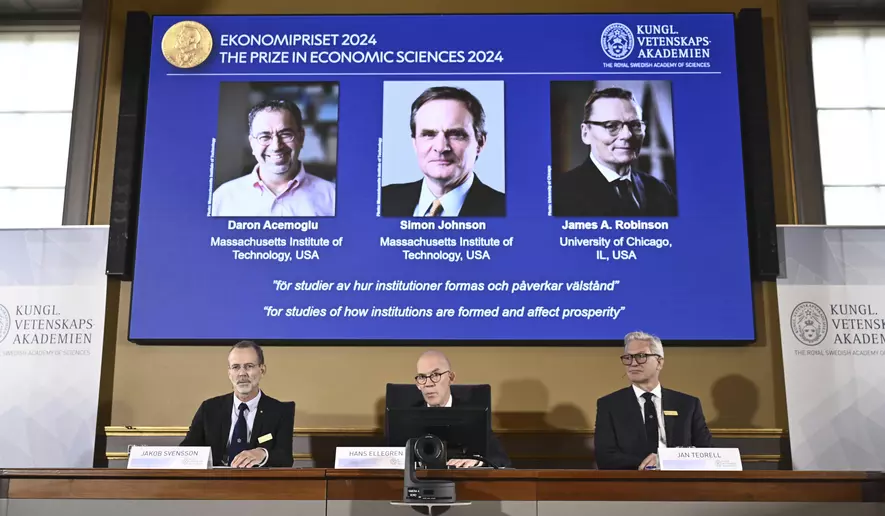
FEATURE: The Royal Swedish Academy of Sciences has awarded the Nobel Prize in Economic Sciences to three US-based economists, Daron Acemoglu, Simon Johnson, and James A. Robinson, for their pioneering research on why some nations are wealthy while others struggle with poverty. Their work has provided valuable insights into how societal institutions shape a country’s prosperity and has addressed one of the most pressing questions in economics: why do such vast differences in wealth exist between nations?
Acemoglu and Johnson, both from the Massachusetts Institute of Technology (MIT), and Robinson, from the University of Chicago, were honored for their studies on how the development and nature of institutions influence the economic trajectory of a nation. Their research demonstrates that the quality of institutions—specifically, whether they serve to include or exploit the population—plays a critical role in a country’s long-term prosperity.
“Societies with poor rule of law and institutions that exploit the population do not generate growth or change for the better,” the Academy explained in its announcement. “The laureates’ research helps us understand why.”
Jakob Svensson, Chair of the Committee for the Prize in Economic Sciences, emphasized the importance of their findings, stating, “Reducing the vast differences in income between countries is one of our time’s greatest challenges. The laureates have demonstrated the importance of societal institutions for achieving this.”
The Impact of Colonization on Institutions
A significant part of Acemoglu, Johnson, and Robinson’s research focuses on how European colonization reshaped institutions across the world, but with varying outcomes. In some colonies, European powers established systems designed to extract natural resources and exploit the indigenous populations for the benefit of the colonizers. In other cases, settlers introduced inclusive political and economic structures that promoted long-term development, particularly for European settlers.
This divergence, the researchers argue, is a crucial reason why former colonies that were once wealthy have become poor, and why some regions that were historically underdeveloped have flourished.
Institutions and the Struggle for Reform
Their work also sheds light on why institutional reforms often fail, particularly in nations where elites maintain control. As long as the political system guarantees that elites will remain in power, no one trusts their promises of future economic reforms. This inability to make credible promises of change prevents real improvements from taking place.
However, the researchers also point out that this lack of trust in the ruling elite can sometimes lead to democratization. In times of crisis or revolution, those in power face a difficult choice: they can either try to appease the population by promising reforms, or, if the public doesn’t believe them, they may be forced to transfer power and establish democratic systems.
“When there is a threat of revolution, the people in power would prefer to remain in control and try to placate the masses,” the Academy noted. “But if the population is unlikely to believe them, the only option may be to transfer power and establish democracy.”
The work of Acemoglu, Johnson, and Robinson has profound implications for understanding the challenges of economic development and inequality across the world. Their research underscores the importance of creating strong, inclusive institutions as a foundation for sustainable growth, offering valuable lessons for policymakers and leaders around the globe.
As nations continue to grapple with the persistent gap between rich and poor countries, the insights provided by these Nobel laureates are more relevant than ever.