
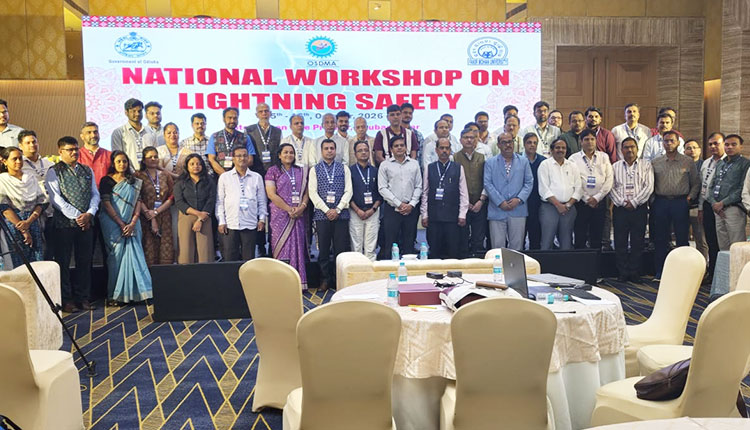
Following a two-day national workshop that ended here, the Odisha State Disaster Management Authority (OSDMA) will create an action plan for 2027 and a Standard Operating Procedure (SOP) for lightning safety with an emphasis on lowering lightning-related fatalities and bolstering emergency response systems. To create an integrated lightning safety plan for the state, experts, scientists, academicians, medical professionals, and disaster management officials convened at the Lemon Tree Premier Hotel. An implementation framework for 2027–2030 was another topic of discussion.
OSDMA Managing Director Rajesh Prabhakar Patil emphasized the importance of going beyond demonstrations and implementing lightning safety measures on a global scale during the closing session. He emphasized how deploying siren systems at the panchayat level may warn people and prevent fatalities. The talks focused on rapid medical attention for individuals hurt by lightning strikes, timely public warnings, and knowledge of the need to relocate to safe areas during lightning strikes. Priority groups for focused safety measures were farmers, agricultural laborers, students, those who operate in open fields, and residents of rural areas.
International-standard lightning and electric shock protection devices, inexpensive lightning-safe shelters, and technology-based early warning systems were all covered in technical sessions. The argument for sensor-equipped lightning-safe shelters in areas dominated by agriculture was made by Associate Professor Dr. Sailendra Kumar Mandal of NIT Patna. A study on lightning safety in Odisha based on the Mayurbhanj district was given by Dr. Biswas Chitale of the Council on Energy, Environment, and Water (CEEW), Pune. Drs. M.C. Sahu of AIIMS Bhubaneswar and A.B. Jena of FM Medical College and Hospital, Balasore, talked on emergency care and life-saving first aid for victims of lightning strikes.
In order to swiftly and easily distribute warnings, participants also investigated the use of SMS alerts, mobile applications, interactive voice response systems (IVRS), sirens, local announcements, and community-based communication networks. Separate safety requirements for farmers, schoolchildren, outdoor workers, and rural communities without access to shelters were demanded in the session. The necessity of a precise system outlining departmental duties, warning levels, emergency response protocols, monitoring, and accountability was also highlighted.
